The Rare Dog That Looks for Peents
A French spaniel saved from extinction, bred for woodcock, and how a line of them ended up in my family. What I've learned about birding with a dog in New York City.
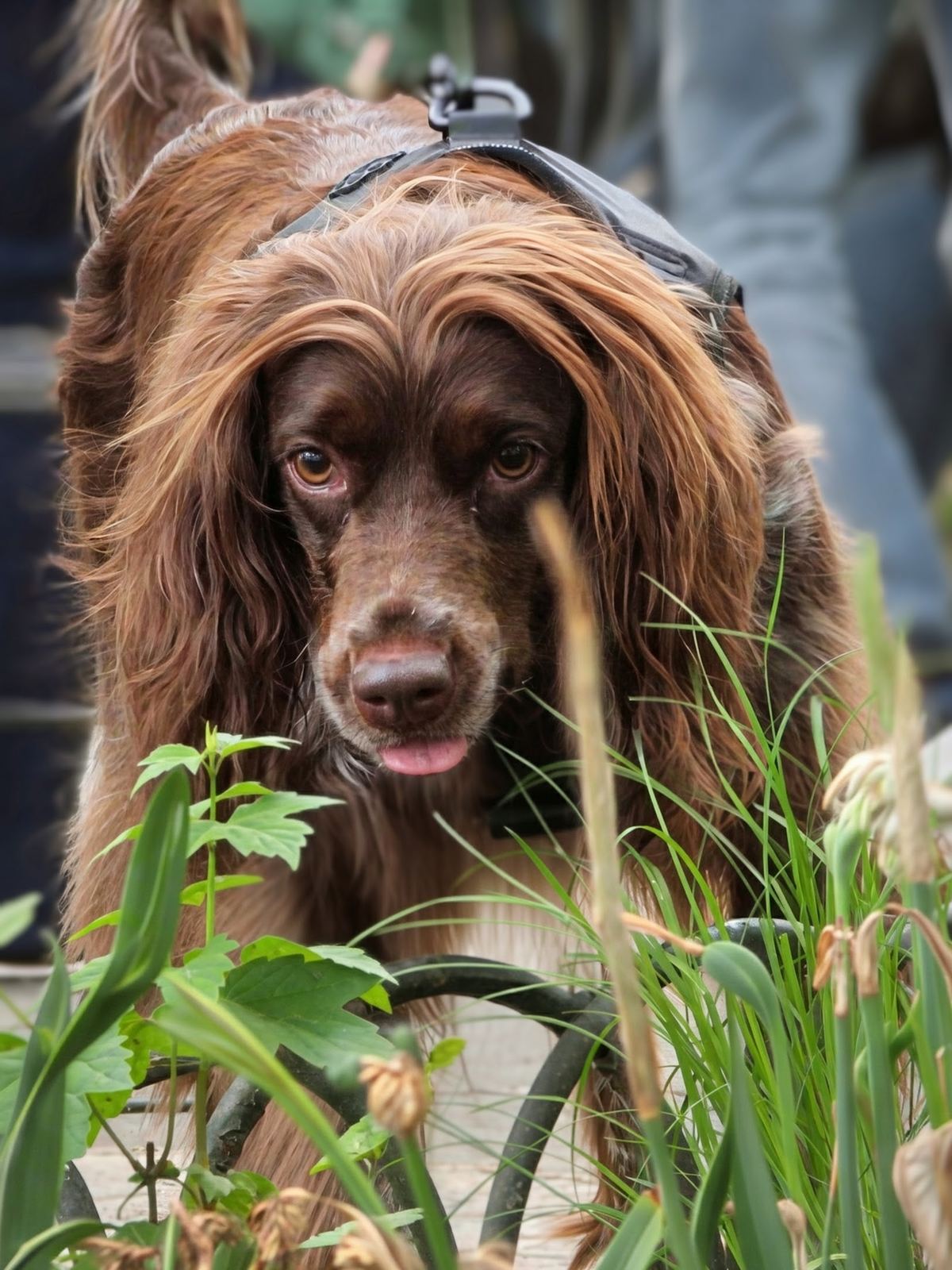
I brought Cherry home from Germany while I was in the Air Force. She had been born there in 2007, to Axel Hehl, a K9 search-and-rescue trainer whose family had been training working dogs for generations. She was an Épagneul de Saint-Usuge, the rarest breed most American birders will never hear about. On weekends I worked with Hehl’s team through cold rural fields looking for scenarios they had set up to test young dogs. Cherry was the dog he set aside for me.
She was bred for woodcock. I didn’t know that at the time. I knew she was a good dog. I knew her breed was unusual, not quite a setter, not quite a spaniel by the American definition of spaniel. She was medium-sized, chestnut-pied on white, with heavily feathered ears and a saber-carried tail he never had docked. I would learn, years later, that every one of those features was specified in a breed standard written in the Bresse region of eastern France in 1936, and that the breed as a whole existed because one rural priest spent thirty-three years saving it after the Second World War nearly took it to zero.
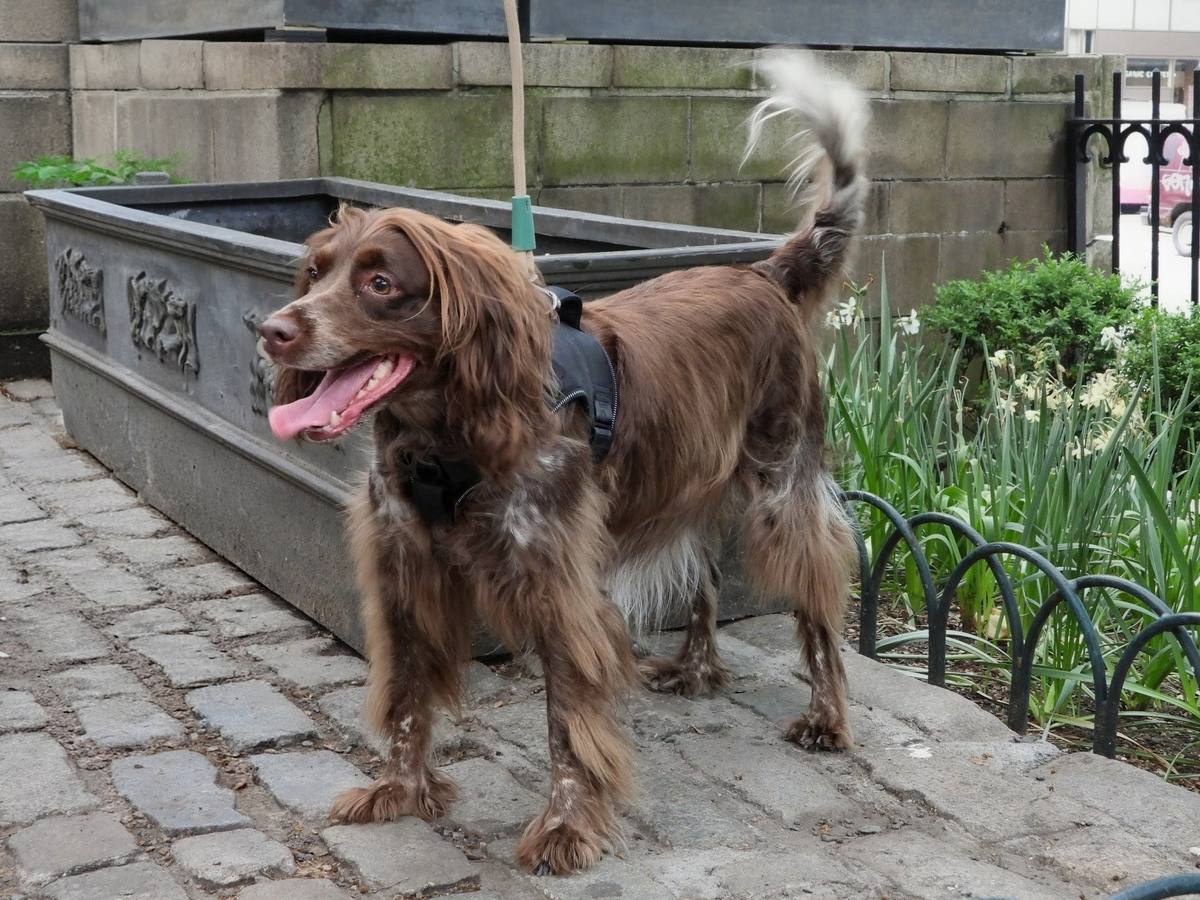
chestnut-pied coat, feathered ears, saber-carried tail.
This is a piece about that priest, the breed he saved, the bird it was bred to hunt, the bird that drew crowds to Bryant Park this spring, and the ethics I carry when I bird with a dog in a city that is full of both.
The priest
Abbé Robert Billard was born in 1912 in the village of Saint-Agnès [6]. He became a priest and, in 1939, was appointed curé of Savigny-en-Revermont, a small commune on the Jura border. He was, per the Club de l’Épagneul de Saint-Usuge’s official history [1], un chasseur de bécasses passionné: a passionate woodcock hunter. He had heard there was a local Bresse spaniel famous for finding bécasses in thick cover, and he wanted one.
Then the war started. Billard was taken as a prisoner of war. He came home in 1945, asked the Société Centrale Canine how to acquire an Épagneul de Saint-Usuge, and was told the breed was extinct. The last dogs had been shown at the Louhans exposition in 1936, and nothing had surfaced since.
He refused the answer. He went farm to farm through the Bresse. In 1946, in the village of Le Fay, he found a female spaniel of reasonably pure type, matching the 1936 standard. He had no money. He sold his gold watch to his brother, so the watch would stay in the family, and used the money to buy the dog. He named her Poupette.
In 1950 in Louhans, he found Dick, a male descended from the 1936 show-winner. The first litter followed. Billard began a cahier d’élevage, a breeding notebook, and started recording each puppy’s woodcock-hunting qualities. He continued for thirty-three years, raising about two hundred and fifty Saint-Usuges at his presbytery in Savigny-en-Revermont [1, 4]. When the genetic base narrowed dangerously in the early 1960s, he went to Germany in 1962 and acquired a Petit Münsterländer female named Bianca von der Rumerburg for fresh blood, because the 1936 Saint-Usuge standard was nearly identical to the Münsterländer’s and the introduction wouldn’t break the type [4].
His Club’s history page calls this un travail de bénédictin: a Benedictine labor, meaning the kind of sustained monastic dedication that takes decades and requires no recognition to continue. His friends called him “le Bob.” He was a fine cook who hosted game dinners after hunts. In 1978 he raised his last litter. On April 6, 1980, he formally handed over his breeding notebook to his friend Serge Bey with the promise that Bey would continue the work.
Bey did. In 1989, the first gathering of Saint-Usuge owners was held at Mervans. Billard attended. The next year, Bey and about fifteen enthusiasts founded the Club de l’Épagneul de Saint-Usuge, with the explicit goal of official recognition. It took thirteen more years. In January 2003, the Société Centrale Canine finally opened the French national registry to the breed [3]. The Club calls Billard le Sauveur de la Race [2]: the Savior of the Breed.
The breed is still rare. The Club de l’Épagneul de Saint-Usuge counts more than 1,200 dogs bred since its founding in 1990, distributed across France and internationally [1]. Most are in France, with secondary populations in Germany, Switzerland, Austria, Canada, and the United States. It is not yet recognized by the Fédération Cynologique Internationale, meaning it is still considered a French national breed rather than a world breed. The Club has the FCI dossier in progress.
Almost none of this story exists in English and is only available from French sources. If you Google the breed in English you will get a paragraph about its rarity and a photo. The man who saved it is called le Sauveur de la Race by the people who knew him, and he is, in the English-language record, effectively a footnote.
The bird
The Épagneul de Saint-Usuge was bred to hunt woodcock. Specifically Scolopax rusticola, the Eurasian Woodcock. A plump, cryptic, long-billed shorebird that forages in leaf litter, migrates at night, performs a dusk display flight on its breeding ground, and is exactly the kind of quarry a pointing spaniel is built for. Billard’s breeding notebook recorded each dog’s woodcock qualities above all others.
The American Woodcock, Scolopax minor, is the same genus. Same body plan. Same cryptic plumage. Same leaf-litter probing. Same role at dusk on the breeding ground. But the Eurasian is bigger. The Eurasian doesn’t peent. Its display, called roding, is a slow patrol above the treetops at dusk, with a sequence of low grunts and a high pist note. The American calls its peent from the ground, then spirals straight up. Those differences are mostly visible to humans. To a pointing dog working ground scent in low cover, both birds are the same task. A dog bred to find Eurasian Woodcocks in the French Bresse, dropped into an eastern deciduous forest during spring migration, responds to American Woodcocks the same way.
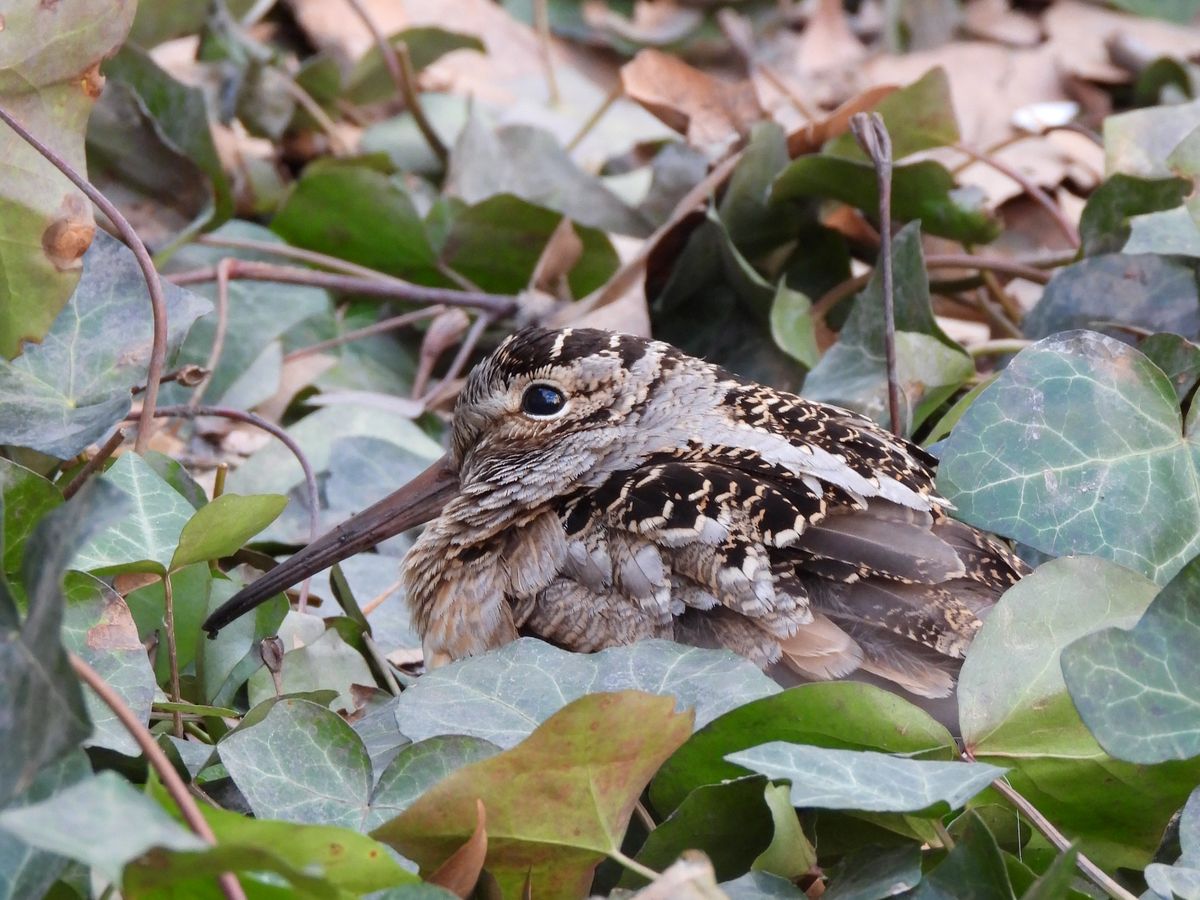
I wrote about American Woodcocks on this site a few weeks ago. When they showed up in Bryant Park this spring and drew hundreds of people to a single bird walk, I went. I stood among the smartphones. I watched a bird the size of a softball walk out of the azaleas and rock its whole weight back and forth as if dancing to music nobody else could hear. I wrote the piece. It’s one of the most-read field notes on shellylynnx.com.
I did not know when I wrote that piece that the dog I brought home from Germany carried a line selected, over decades in a French presbytery, precisely for the ability to find the cousin of that bird. The connection was always there. I just hadn’t found it yet.
The paradox, and how I live with it
Now the part that makes this complicated.
I’m a birder. What I write on this site is how to bird New York City without a car, which means a lot of small parks with ground-nesting species, migration stopovers where exhausted warblers are trying to feed, and stretches of coastline where Piping Plovers nest in the sand above the tide line. The birds I care about are the same birds a pointing spaniel was bred to pursue. That paradox does not resolve itself by ignoring it.
Cherry was trained for search and rescue, and she came home with me at the end of my time in Germany. She had one litter in 2012, five puppies. She lived to sixteen and a half. She is the reason the line continued in my family at all. My sister has two Saint-Usuges now: Hannah, from that litter, who lived with a close friend of mine for most of her life and came to my sister after the friend could no longer keep her; and Coral, who came into the family a few years later through the Saint-Usuge community online. The breed is small enough in the United States that most of the dogs here are closely related. Neither Coral nor Hannah has ever hunted.
But they are not generic pets. The breed’s instincts are real in this family. Earlier dogs in my family worked the way Billard bred them to work: nose to ground, scan for emanation, point. The breed is polyvalent; in the United States, most Saint-Usuges work quail rather than woodcock, because that’s the American pointing-dog tradition. Coral and Hannah don’t do that in the field because nobody works them that way now. What they carry is the architecture. You can love a Saint-Usuge and walk her through Central Park. You cannot forget what she was bred to do.

Which means that if you bird New York City with a dog, any dog, you have to do the work to not cause the harm that pointing breeds are otherwise engineered for. Here is what I’ve learned.
Leash discipline is the first rule and the last rule. Most of the ground-nesting birds in NYC parks are present for a narrow seasonal window, and the window overlaps with the part of the year most dog owners most want to be in those parks. Late March and April for spring woodcock passage through Bryant Park, and October through November for the fall return. April through July for Ovenbird, Veery, and other ground-nesting migrants in Central Park and Prospect Park. April through August for Piping Plover on the Rockaway beaches. Your dog does not know which park she is in. You do. The 9 p.m. to 9 a.m. off-leash window that Central Park and Prospect Park permit is a compromise worth defending, not a permission to stretch.
Avoid specific sites during breeding season. Breezy Point and the Rockaways during Piping Plover nesting is the most important one. The closures are posted and enforced, though not enough. Stay out when they are active. Inland equivalents are less formally marked but equally important: the interior of the Ramble in May, Prospect Park’s Midwood in June, Van Cortlandt’s nature trails in early summer. The interior of the Ramble in particular is where migrating warblers drop to rest at dawn after a night of flight. A dog off-leash through that understory is the most direct form of ecological damage a single person can do in a single morning.
Train recall before you need it. The most responsible dog owners I know are the ones whose dogs come when called with zero hesitation. That training takes months, sometimes years. It is the only reliable tool for handling the unexpected rabbit, the neighbor’s cat, or the nearby bird. If your dog’s recall isn’t absolute, a leash is the workaround, and also the responsible position until the recall is in place.
Know your dog’s prey drive. Not all dogs are built the same. A Saint-Usuge in the Ramble in May is a different risk profile than a Saint Bernard. If you have a hunting breed or a breed with strong prey instinct (spaniel, setter, pointer, retriever, sighthound), the rules tighten. These are not abstract housepets. They are purpose-bred attention devices, and they see birds.
Cat-free is bird-free is dog-management. This one doesn’t get said often enough. Feral and indoor-outdoor cats are the largest predator of songbirds in urban North America [5]. Dog owners, cat owners, and birders are sometimes treated as three separate camps. They are not. If you love birds, you advocate for indoor cats. If you love dogs, you advocate for the trap-neuter-release programs that reduce feral cat populations. These positions are aligned.
The tool
I built NYC Off-Leash because of the tension this piece is describing. It’s a map of the city’s dog runs and off-leash-permitted spaces, with a way to report maintenance issues and wildlife incidents. The design choice was to lead with what dog owners actually need, not with where dogs are banned.
Dog runs first, then everything else.
If every dog owner in the city had a quality dog run within ten minutes’ walk, the pressure on the rest of the park system would drop by more than most birders expect. The piece of the problem I can actually move is infrastructure, not enforcement. Enforcement is slow, hostile, and inconsistent; it makes dog owners feel attacked and birders feel unheard. Better infrastructure makes both camps’ lives easier and protects the animals that can’t advocate for themselves.
If you have a dog in New York, the map is free. If you have a dog and also care about birds, it’s arguably even more useful. The tool exists because the bird ethics I believe in have to make room for the Saint-Usuge line in my family’s household, and for the fact that we all share a city.
What I carry
I think about Abbé Billard most mornings when I walk past dogs in my neighborhood. He was a rural priest in a country that had just lost hundreds of thousands of its own people and almost all of one small regional breed of hunting dog. He chose a thirty-three-year project that nobody asked him to do. He sold his gold watch to get started. He wrote each dog’s qualities in a notebook. The breed exists today because of him.
The rare dog that looks for peents is not an accident. It is the outcome of one specific person choosing to care for a long time without a guaranteed payoff. Conservation of anything rare is like that. The Okinawa Rail exists because someone traps mongoose and runs trap-neuter-release on feral cats in the Yanbaru forest. The Bryant Park woodcocks have a chance every migration because NYC Bird Alliance fought for bird-friendly building standards in this city. The Épagneul de Saint-Usuge exists because one man drove farm to farm in 1946 with the sound of “the breed is extinct” in his ears, and refused it.
Cherry is a link in that chain. Coral and Hannah are the next links. The woodcocks in Bryant Park are another link. I am another link, and so are the readers who decided to care about these specific birds today. The rare breed and the bird it was bred to find can both keep existing if the people who hold the ends of the chain remember they are holding something.
Walk your dog on a leash in May in the Ramble. Report the dog run near you that needs maintenance. Keep your cat inside. Read the French sources if you can, because the English-language record is thin and a better record is a small kind of conservation too.
That’s where I’m writing from. The dog on the leash. The chain still holding.
Birds Mentioned
Subway Routes
Show routes (4)
- BDFM7Bryant Park (American Woodcock spring migration stopover)B, D, F, or M to 42 St-Bryant Park, or 7 to 5 Av. Walk slowly along the shaded edges in late March and April. The woodcocks favor leaf litter under the azaleas.
- BC16Central Park, the Ramble (Ovenbird and Veery breeding habitat)B or C to 72 St or 81 St-Museum of Natural History, then walk east into the park. The 9 p.m. to 9 a.m. off-leash window applies elsewhere; the Ramble itself is leash-on for ground-nesting species through May and June.
- 23FGBQProspect Park, the Midwood (Ovenbird, Veery, ground-nesting migrants)F or G to 15 St-Prospect Park for the south end, 2 or 3 to Grand Army Plaza for the north entrance. The Midwood interior is closed-canopy forest where ground nesters drop in to breed; leash-on through summer.
- AQ22Breezy Point / Rockaway (Piping Plover nesting)A train to Rockaway Park-Beach 116 St, then Q22 west toward Riis Park / Breezy Point. Closure signs are posted at the dunes April through August. Dogs are not permitted in the nesting areas even when leashed.
Credits
All photographs by Shelly Xiong. Coral portraits in Bryant Park; American Woodcock in Bryant Park, spring 2026.
References
Show references (6)
- Club de l'Épagneul de Saint-Usuge. Histoire, Official Club history page
- Adeline Guillemaut. Coup d'oeil sur : l'Epagneul de Saint-Usuge, Écho Bressan, April 2022
- Société Centrale Canine. Épagneul de saint usuge, Breed entry, French national kennel club
- Jean-Pierre Duverne. Chroniques de l'épagneul de Saint-Usuge : le chien, le club, les hommes et la cynophilie, Jean-Pierre Duverne, Le Creusot, 2020. 348 pp. ISBN 979-10-699-4630-9
- Scott R. Loss, Tom Will, and Peter P. Marra. The impact of free-ranging domestic cats on wildlife of the United States, Nature Communications 4, 1396, 2013
- Diocèse d'Autun. Visage : BILLARD Robert, Visages du Diocèse d'Autun (Saône-et-Loire), biographical record. Confirms birth April 29, 1912 in Saint-Agnès (Jura); ordained June 6, 1936; named curé of Savigny-en-Revermont in 1939; POW 1939–45; died 2000.