Celebrity Birds: The Bryant Park Woodcocks
The American Woodcocks that took over Bryant Park this spring, the sound everyone got wrong, and the window-strike story TikTok didn't cover.
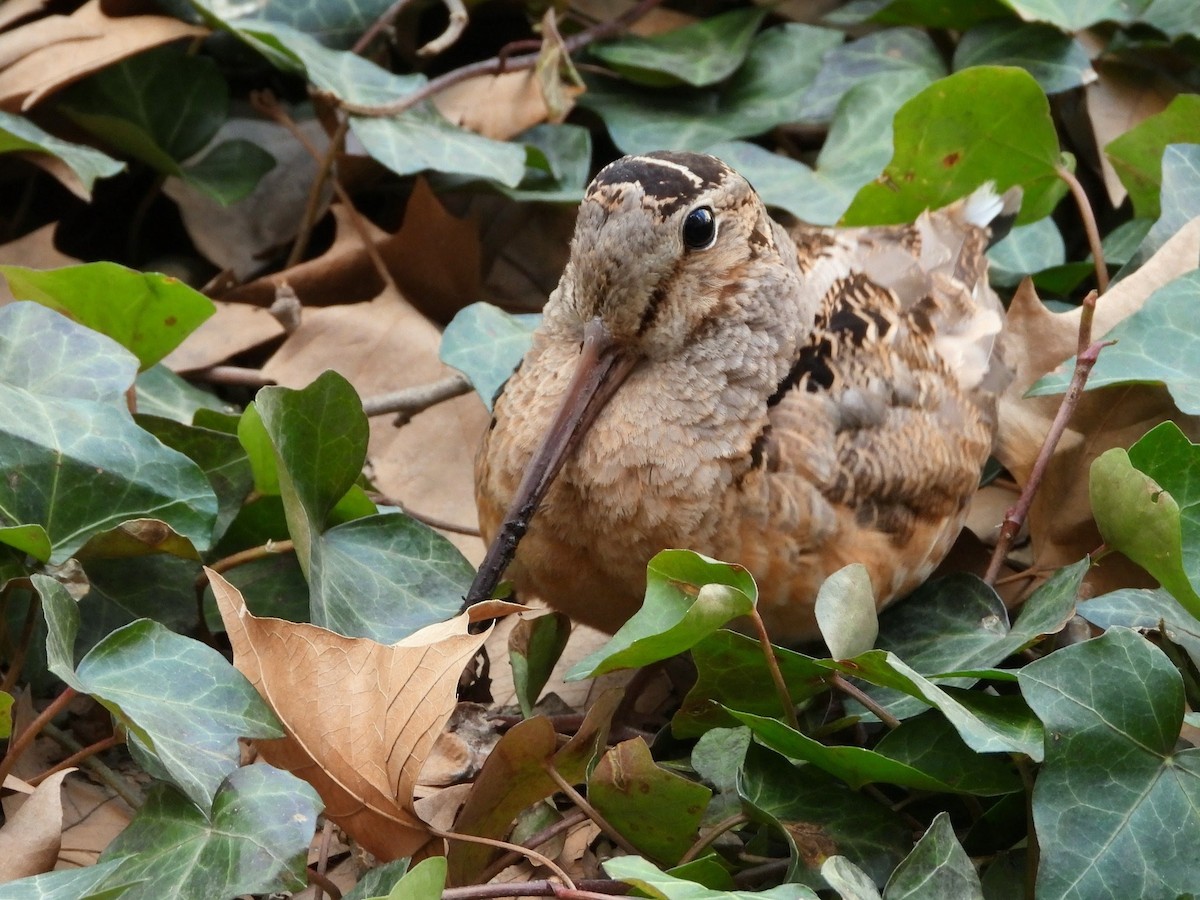
I always try to keep a respectful distance whenever I run into a celeb. Unfortunately for me and six hundred and forty-nine other people, so do the woodcocks.
In late March, an American Woodcock arrived at Bryant Park. Then another. Then several. By early April, crowds of bird fans were showing up daily to stand on the midtown lawn with their smartphones raised, waiting for a plump brown shorebird the size of a softball to come out of the brush and do what woodcocks do: walk around rocking their entire body back and forth as if dancing to music nobody else can hear [1, 2].
More than six hundred and fifty people showed up for one of the park’s woodcock-focused bird walks, according to the reporting. The naturalist leading it, Gabriel Willow, told reporters they’d needed “bird security” [4].
Who they are
American Woodcocks (Scolopax minor) are shorebirds that don’t act like shorebirds. They breed across the eastern U.S. and Canada, feed in forest floor leaf litter, and migrate at night, often over a hundred miles in a single stretch, from wintering grounds in the southern U.S. up to the Northeast and Upper Midwest [3].
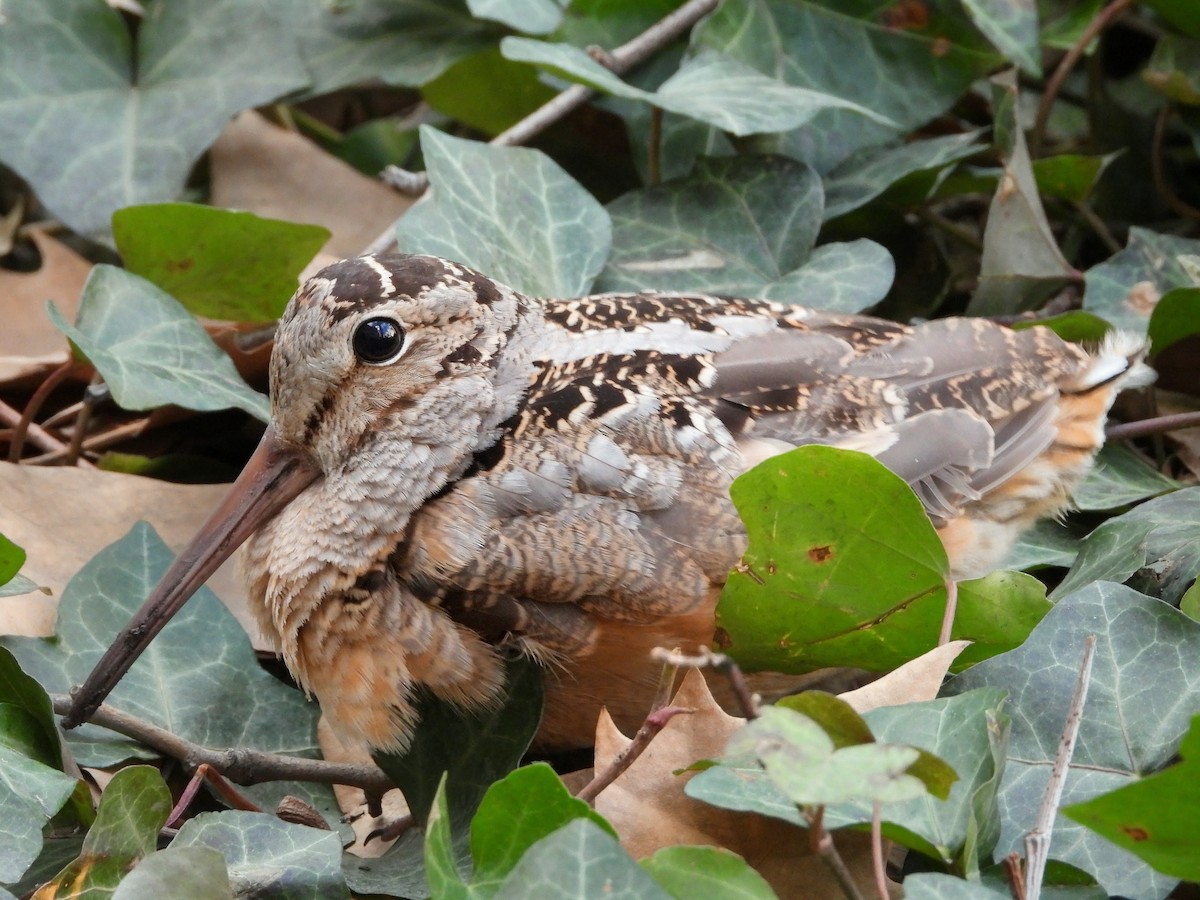
They are also, not to belabor it, extremely charismatic. They are round. Their beaks are comically long. Their eyes sit so far back on their heads that their field of view wraps almost completely around them, giving them panoramic awareness above and behind while they’re head-down in the leaves. Their formal name is American Woodcock, but they go by many others: timberdoodle, bogsucker, mud bat. Most of which sound like Bandcamp genre tags.
The dance
The thing that made them go viral, the full-body bob-bob-bob, is a foraging behavior, not a mating display. Ornithologists think the vibration may cause earthworms in the soil to move, making them easier to detect; others think it’s an anti-predator move [4]. What’s not up for debate is that it looks spectacular when set to the right music.
Bryant Park’s own social team posted a clip of a woodcock set to the Black Eyed Peas’ “Rock That Body,” which somehow became the definitive version of this news cycle and was cited by half the coverage [1, 5]. TimeOut NY, Gothamist, HuffPost, US News, NBC, The Mirror, Smithsonian Magazine. Everybody wrote about them [1, 5, 6, 7].
The sound most people get wrong
If you’ve watched the Bryant Park clips, you’ve probably seen captions guessing at the call: “meep,” “squeak,” “chirp.” Those are close, but none of them are the word. The word is peent [10].
It’s a single, buzzy, nasal, 0.2-second note that a male gives at dusk and dawn from a display ground in early spring. Peent is the opening beat of the sky dance, his mating display. He peents on the ground, launches straight up in a wide spiral as high as 350 feet, and comes back down in a zigzag while chirping musically. The twittering you hear on the ascent is not vocal at all; it’s wind moving through three specially narrowed outer primary wing feathers [10].
Bryant Park is not a display ground. It’s a stopover. The birds there are migrants stopping to rest, not courting males on their breeding turf, so the full sky dance is not what a lunch crowd is going to see on a Midtown lawn. If you want the real thing, you have to leave Midtown: Floyd Bennett Field in Brooklyn and Jamaica Bay Wildlife Refuge are the spots NYC-area birders typically recommend for the spring display.
Also, while we’re here: their eyes sit so far back in the skull that their ear openings have been pushed to below the eyes, instead of behind them like in most birds. Their brain is effectively upside down inside their skull to make room [11]. This is a bird whose anatomy was rebuilt from the ground up to watch for predators while head-down in leaf litter. The bob is a feature. The dance is a feature. The evolution is wild.
Why Bryant Park
Woodcocks are stopover birds, not long-term residents. They arrive in a migration wave, rest, refuel, and continue north. Bryant Park is a weirdly excellent stopover site because its small patches of bare soil and low vegetation look enough like the forest floor these birds need to refuel. Jamaica Bay and Prospect Park also host them; Bryant Park just happens to be in Midtown, where twenty-five thousand people can cross the lawn on a single warm afternoon [9].
The birds don’t know that. From their perspective, a patch of mulch is a patch of mulch.
The conservation footnote nobody mentions
While not endangered, American Woodcock populations have declined significantly over the last several decades. Habitat loss, mostly [8]. The Ruffed Grouse Society, which does habitat work for woodcocks and grouse, put out a piece pointing out that the Bryant Park viral moment is an accidental conservation opportunity [8]. More people learned what a woodcock was in three weeks than in the previous decade.
Which is, I think, the best thing that can happen to a declining species. One shows up somewhere famous. It gets a nickname. Everyone pays attention for a minute. Some of them stay paying attention.
The part TikTok didn’t cover
Forty-five blocks uptown from Bryant Park, on the Upper West Side, there’s a wildlife hospital that sees a different side of woodcock season. Manhattan’s Wild Bird Fund, which Rita McMahon started out of her Upper West Side apartment in 2001 and incorporated as a nonprofit in 2005, now runs out of 565 Columbus Avenue. It admits woodcocks every spring with head trauma, eye injuries, and broken beaks from window strikes. The clinic reports receiving more than fifty of them in recent years, concentrated in March and early April, the same weeks the Bryant Park videos are going viral [12].
Two-thirds of those birds die on arrival [12]. Of the woodcock collision victims tracked in the most rigorous peer-reviewed study to date, a multi-year survey in Minneapolis, only 39 percent were ultimately released back to the wild [13].
The vulnerability is built in. Woodcocks migrate at night, fly low, and are plump and short-winged, which means they cannot bank fast when something appears in front of them. When they come down into Manhattan, they’re exhausted, often grounded by a sudden weather shift, and looking for any patch of bare soil that resembles a forest floor. A reflection of sky in an office window reads the same way from their angle. They hit the glass at full speed.
Wild Bird Fund treats more than seven thousand birds a year, and window strikes are the leading cause of injury across all species they see [12]. NYC Bird Alliance runs Project Safe Flight, the volunteer program that documents collisions block by block across Manhattan through both migration seasons; their data was central to the advocacy that produced Local Law 15 of 2020, the bird-safe glass rule for new construction in the city [14].
If you find a grounded or stunned woodcock in April, do not pick it up with bare hands, do not try to feed it, and do not let it loose indoors. Put it in a paper bag or a covered shoebox with a towel in the bottom, keep it dark and quiet, and call Wild Bird Fund. The goal is to get it into calm, trained hands as fast as you can.
The Bryant Park woodcocks are survivors. They are the ones who picked the lawn instead of the window. Watching one dance on mulch in Midtown is a chance to meet a bird that a lot of its cohort didn’t live to become.
My respectful distance
In spring, I go to Bryant Park. I find a chair. I wait. The timberdoodle either shows up or doesn’t. Both are fine. Either way, the bird gets to rest, which is the whole point of the stopover.
Birds Mentioned
Subway Routes
Show routes (4)
- BDFM7Bryant ParkB, D, F, or M to 42 St-Bryant Park puts you directly under the park's southwest corner. 7 to 5 Av is at the east end. From Times Sq-42 St or Grand Central-42 St, walk two or three blocks. The B is weekday-only; D, F, M, and 7 run all day.
- 1BCWild Bird Fund, 565 Columbus Avenue1 to 86 St, then one block east on 86th to Columbus. Or B or C to 86 St (Central Park West), then one block west. The clinic sits between 87th and 88th. Call ahead if you're bringing in an injured bird.
- 2Q35Floyd Bennett Field (woodcock display grounds)2 train to Flatbush Av-Brooklyn College, then Q35 south toward Rockaway Park. Get off just before the Marine Parkway Bridge at the Floyd Bennett Field entrance on Flatbush Ave. Plan on about an hour from Midtown.
- AQ52 SBSQ53 SBSJamaica Bay Wildlife Refuge (woodcock display grounds)A train to Broad Channel, then a 20-minute walk north along Cross Bay Blvd to the visitor center. Q52 SBS or Q53 SBS stops at the Refuge entrance.
Credits
All photographs by Shelly Xiong, archived at the Macaulay Library, Cornell Lab of Ornithology. Asset IDs: 653024535, 653024543. Video by Shelly Xiong, Bryant Park, March 2026.
References
Show references (14)
- Rock it like a woodcock: This Bryant Park bogsucker is NYC's latest 'it bird', Gothamist
- Migrating bird earns massive crowd in New York City's Bryant Park, The Cool Down
- All About Birds: American Woodcock, Cornell Lab of Ornithology
- These Rotund and 'Charmingly Goofy' Birds Are Delighting New Yorkers and Dancing on Social Media, Smithsonian Magazine
- NYC's newest celebrity: The rare American woodcock dancing in Bryant Park, NBC New York
- New Yorkers Are Flocking To The Park For These Birds And Their Viral Strut, HuffPost
- The viral dancing bird is back in Bryant Park, TimeOut NY
- Viral Woodcock in Bryant Park Highlights a Serious Conservation Story Beneath the Dance Moves, Ruffed Grouse Society
- The Park, Bryant Park Corporation
- All About Birds: American Woodcock Sounds, Cornell Lab of Ornithology
- Why the American Woodcock's Ears Are Below Its Big Eyes, Audubon
- American Woodcock, Wild Bird Fund
- Loss, S. R., Lao, S., Anderson, A. W., Blair, R. B., Eckles, J. W., & Turner, R. J.. Inclement weather and American woodcock building collisions during spring migration, Wildlife Biology, 2020
- Project Safe Flight: Monitoring and Research, NYC Bird Alliance