The Theater With No Screen, The Beach With No Dogs
A volunteer's first months with the NYC Plover Project. Building the symbolic fence in March, learning the protocols in May, and the conversation about your dog.
On a Saturday morning in May, I sat in a folding chair inside the Post Theatre at Fort Tilden for my orientation as a NYC Plover Project volunteer. Although the original movie screen was gone, a stage stood in its place with theater lighting rigged above it. This transformation occurred because the Rockaway Theatre Company took over the historic base theater through an agreement with the National Park Service, which allowed them to restore the building in exchange for staging live productions [5].
The room felt deeply familiar to me because my father served in the Army and the Army National Guard. Throughout my childhood, I grew up standing for the Star-Spangled Banner before every movie shown on his posts. Later, when I joined the Air Force and was stationed in Germany, the anthem played before every film there as well. Both of these theaters were run by AAFES, utilizing the exact same anthem clip and eliciting the same crowd cheer at the end despite being decades apart.
A military base encompassed far more than just a workplace, serving as a complete community that included a commissary, BX, PX, school, chapel, and movie theater. Now, the plovers also call this area home. While no anthem played during our orientation and the movie screen was long gone, I was there to learn how to monitor these new residents.
The bird
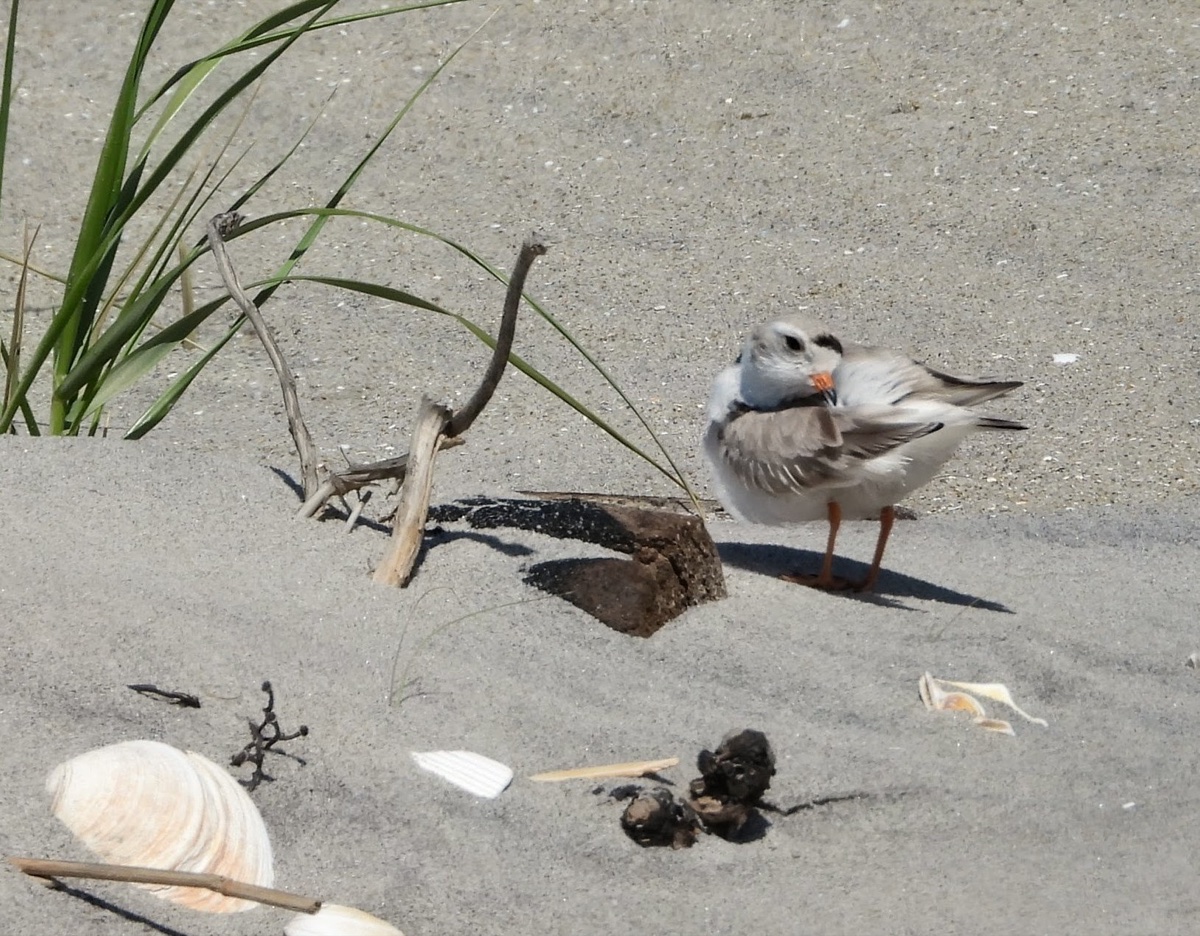
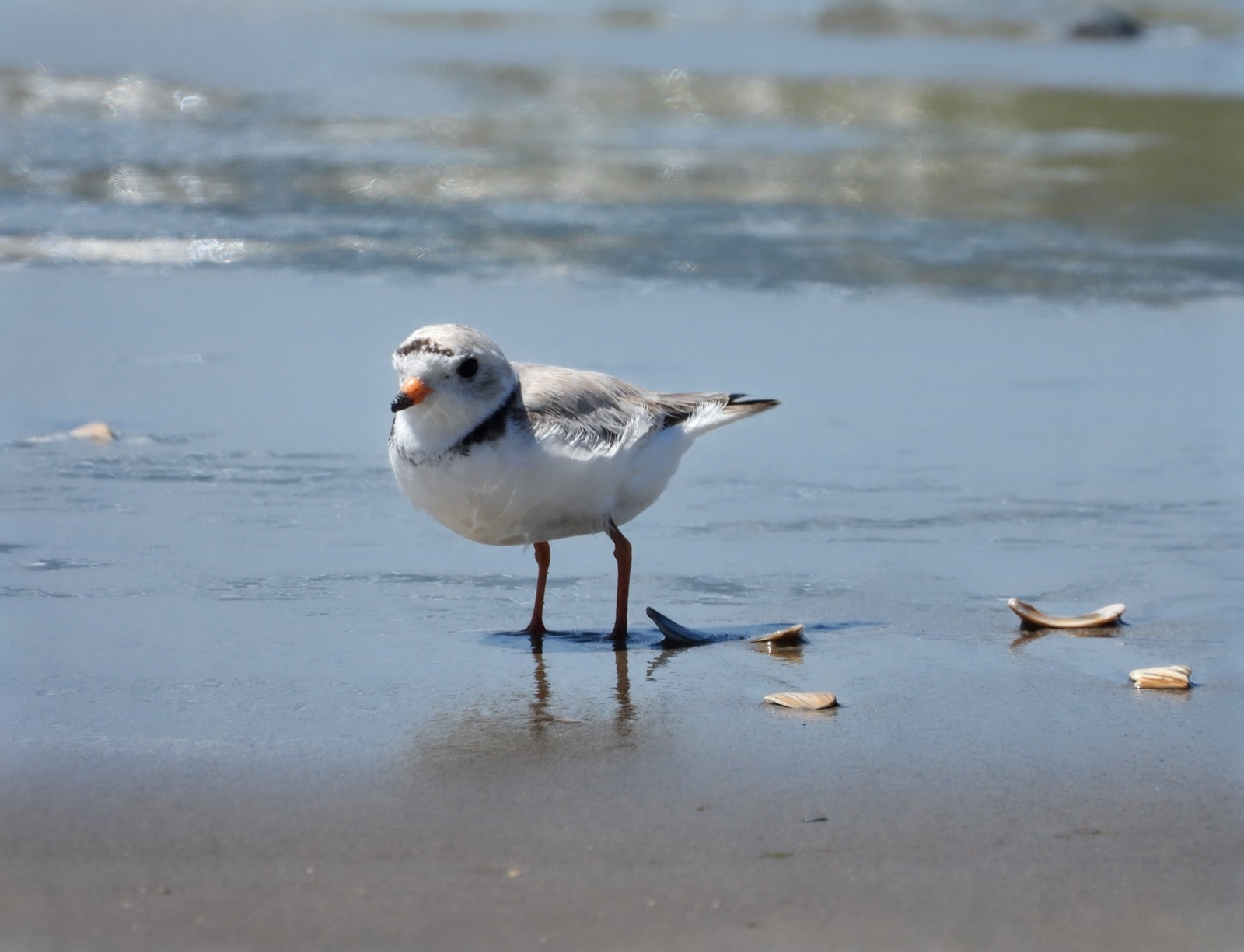
The Piping Plover is a small shorebird, sand-colored on top and white below, with a black band across the forehead and a black collar in breeding plumage. It weighs about two ounces. It nests on bare beach above the high-tide line, laying four eggs in a shallow scrape in the sand. The eggs are the color of the sand. The chicks are the color of the sand. The whole strategy is invisibility in a thin band of habitat humans want to walk on.
The Atlantic Coast population was listed as Threatened under the Endangered Species Act in 1986. The smaller Great Lakes population was listed as Endangered the same year. Both had been pushed there by a century of pressure: market hunting in the 1800s for the millinery trade, then 20th-century beach development, human recreation, and a list of predators that includes feral cats, foxes, raccoons, and free-ranging dogs [1]. There were about 790 Atlantic Coast breeding pairs at the time of listing. Recovery has been uneven. Massachusetts is the success story, with about 1,200 nesting pairs [6]. Maryland and Virginia have declined. New York’s Rockaway Peninsula holds about 50 breeding pairs across federal, city, and private beaches.
The plover nests at the Rockaways partly because the Army held Fort Tilden from the early 20th century through 1974, first as a coastal artillery post and later as a Nike anti-aircraft missile site. For most of those decades the dunes were behind a fence, off-limits to the development that transformed the rest of the Rockaway shoreline. The Army’s reasons had nothing to do with the bird. The bird was incidental.
The conversion to a national park was not inevitable either. In the early 1970s, the Nike system was being phased out and Congress was building the federal environmental framework that would soon include the Endangered Species Act, signed into law on December 28, 1973. Before that, Public Law 92-592 established Gateway National Recreation Area on October 27, 1972. When the Army closed Fort Tilden in 1974, the mechanism to absorb the site was already there. The dunes did not become condos. They became Gateway. The plovers kept using them. The NYC Plover Project, founded in 2021, puts up the new fence each spring [4].
Out to the beach
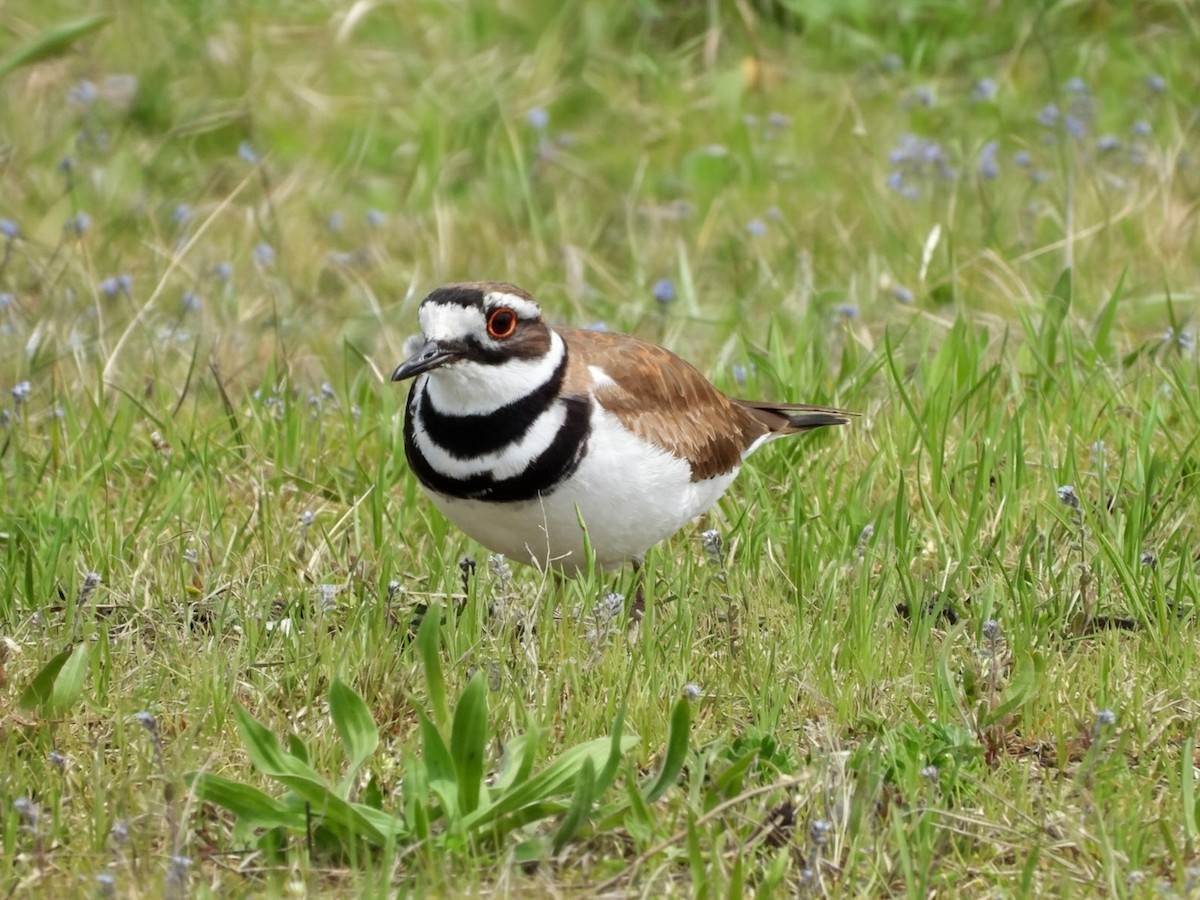
After orientation, the group walked from the Post Theatre to the beach. On the way we stopped at the soccer field next to the parking lot. A pair of Killdeer were nesting there. Same genus, same shallow-scrape strategy, same broken-wing display when a predator approaches. The difference is that Killdeer are comfortable in the open. Piping Plovers are not.
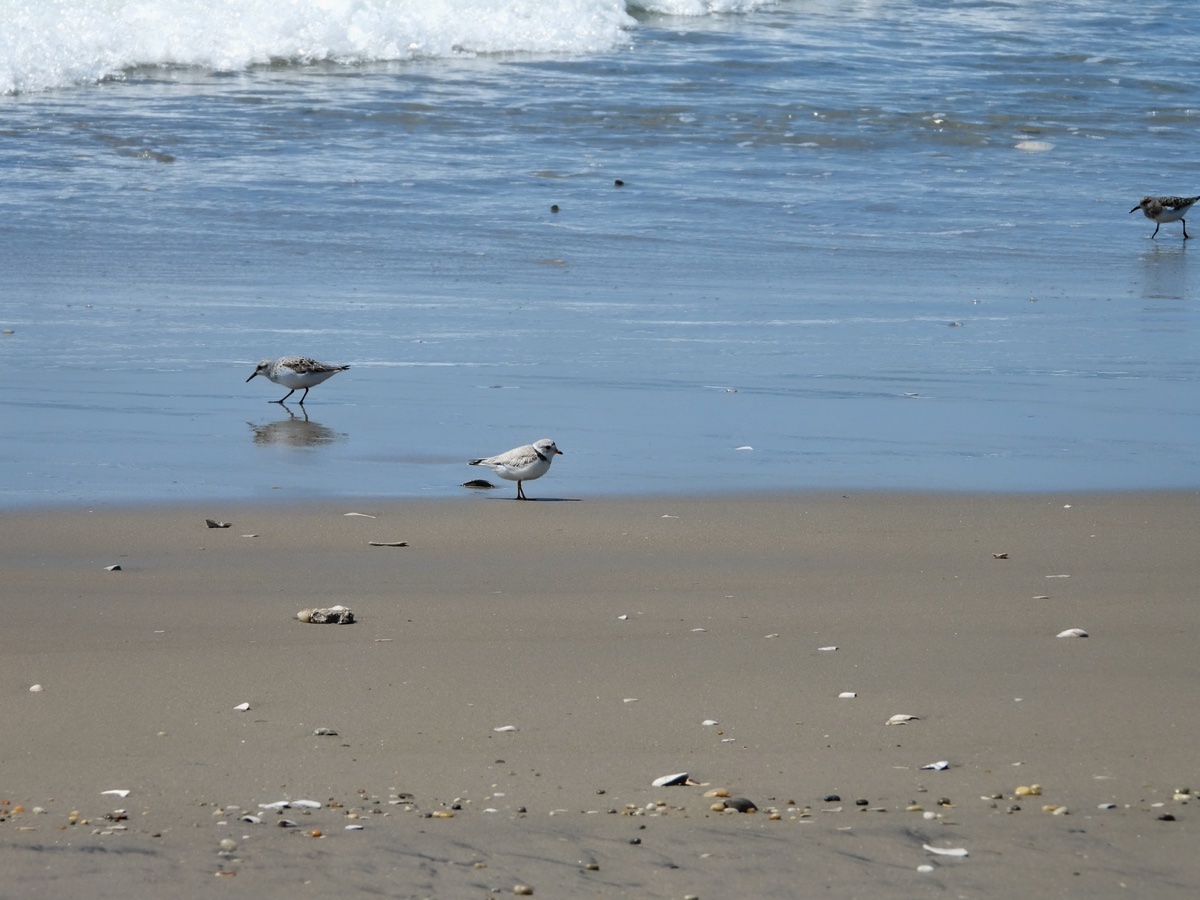
Out on the beach we carried binoculars and were taught how to count plovers without approaching. We were shown the stringline fencing that runs along the dunes during plover season, March 15 through September 15. We were shown the closure signs and the scrape in the sand. We were taught that we were volunteers, not enforcement. We could not write tickets. However, we could explain the rules. The Park Police could write tickets, and the fines for a dog on a closure beach ran into the hundreds of dollars [2, 3].
I had been on this beach before. On March 14, I came out to Jacob Riis Park with other volunteers to install the fence. We worked in groups of four: one tied stringline around the metal posts, one made loops along the line, two added the pink warning ribbons. We learned the rhythm fast. Strangers became a crew in an hour. The fence ran from the parking lot at Riis past the dunes toward Breezy Point Tip. Then the season started. Then the plovers came back. Then the dogs and kite-flyers and beach drivers came back too. The fence was meant to hold.
The classroom walked through the biology I had already been learning on the beach. A dog does not have to attack a plover to harm it. A dog in the nesting area is read as a predator. The adults leave the nest and try to lure it away. If they leave too often or too long, the eggs cool. The chicks freeze. The nest fails. Presence is the harm.
Three conversations
I have so far witnessed three conversations between Plover Project volunteers and dog owners on these beaches. One was on the orientation walk on May 2. Two were on my shadow shift on May 16.
The pattern is similar each time. The dog is on the beach. Sometimes leashed, sometimes not. The leash is not the issue. The dog being on the beach during plover season is. The volunteer approaches, friendly, explains who they are, points at the signs and the fence, and explains that the closure runs from March 15 through September 15. The dog owner responds. Some are gracious and surprised and walk the dog back toward the parking lot. Some are defensive. Some want to argue. Almost all say their dog is friendly. The plover does not care.
What surprised me was the calibration the volunteers used. They did not start from the rule. They started from the bird. The bird is small. The bird is nesting just there. The bird can see your dog from a long way away. Your dog does not need to do anything. The bird’s response is to leave the nest. The eggs cool. By the time the conversation gets to the rule, the dog owner has already heard why it matters. The bird comes first.
I have not yet had this conversation alone. I am learning how. The volunteer I shadowed did it twice on May 16, both times with the same calibration and the same outcome. In one case the dog owner apologized and walked back. In the other, the dog owner argued, then left. Both dogs ended up off the closure. The volunteer ended where she started, walking the beach and counting plovers.
No dogs on the beach
This is the work: no dogs on the beach during plover season. Not just no off-leash dogs. No dogs at all on the ocean-side beach at Jacob Riis Park, Fort Tilden, or Breezy Point Tip, and no dogs on the bayside of Breezy Point Tip, from March 15 through September 15. The rule is unambiguous. The reason is the same as the rule. The plover cannot tell that your dog is friendly. The plover sees a predator, and that can mean the difference between a brood that fledges and one that does not.
I published a piece on this site last week about my own dog, an Épagneul de Saint-Usuge brought home from Germany years ago. That piece argued for leash discipline in the Ramble year-round and for staying off the Rockaways from spring through late summer because of Piping Plover nesting. I am not the person who walks a dog through the closure and tells a Plover Project volunteer that my dog is friendly. I am the person learning to make the request. Love the dog. Hold the dog back from the bird. Sometimes that means a leash. Sometimes, here, it means a different beach.
The closure is not the end of the conversation. Dogs need beaches too. Riis and Fort Tilden are open to dogs from September 15 through March 14. Prospect Park’s off-leash hours hold year-round. Marine Park’s bay area is open. The list is short. Telling dog owners to stay off the closure beach in spring is the right ask. It would be easier if the city had more dog-friendly beaches and dog runs to send people to in the first place [7]. I keep a map of the city’s dog-permitted spaces at NYC Off-Leash, partly because of this. Enforcement is the floor. Infrastructure is the work that makes enforcement easier.
What I carry
The volunteer asking a dog owner to leave the closure is doing a gesture I have seen all my life. The MP, short for Military Police, at the gate of an Army post. The federal sign that says KEEP OUT. The shape of the work is military. The MP wore a uniform. The Park Police carries a badge. The volunteer wears a bright blue Plover Project t-shirt. The move is the same: hold people back from ground that is closed for reasons most of them will never know.
The Army held the dunes at Fort Tilden for weapons. The National Park Service holds the same dunes now for egg nests in a scrape behind a different fence. The fence is easier to ignore. The stake is no smaller.
The Post Theatre is part of the same arc. The room played the anthem for soldiers stationed at Fort Tilden. The post closed. The room sat empty for years. A theater company took over, removed the screen, built a stage, and started running live productions. I sat through orientation in the room where soldiers used to stand for a movie and an anthem before it. The job I was being trained for is a civilian version of the job those soldiers did at the gate.
The plovers are the new residents. They arrive in March from the Gulf and the Caribbean. They pair up. They lay four eggs in a scrape in the sand. They defend their territory. They raise chicks through the summer. By September they are gone, and the next March a new generation comes back, sometimes to the same square of dune. They raise their families on base. The fence we build in March is the perimeter the families live behind.
The bird does not know any of this. It knows the dunes, the open sand, and the line where people stop. It knows that spring can be held long enough for eggs to become chicks. My job is to make that possible: move the people back, move the dogs back, hold the line until September 15, then take the fence down and start again next March. The wind comes off the bay, the ribbons twisting, and the line holds.
Birds Mentioned
Subway Routes
Show routes (2)
- 2Q35Jacob Riis Park and Fort Tilden2 train to Flatbush Av-Brooklyn College, then Q35 south toward Rockaway Park. The Q35 stops at the Riis Park parking lot and continues to Fort Tilden. About an hour from Midtown. The Post Theatre, orientation sessions, and bayside parking are on the Fort Tilden side.
- AQ22Q35Breezy Point Tip (westernmost closure)A train (Rockaway Park branch) to Beach 116 St, then Q22 westbound toward its terminus. About 30 minutes on foot from the Q22 terminus to the closure at the Tip. Alternative: Q35 to Riis Park and walk west along the beach (long walk, only at low tide).
Credits
All photographs by Shelly Xiong. Killdeer image archived at the Macaulay Library, Cornell Lab of Ornithology, asset ID 656791319, from eBird checklist S331230491 (Fort Tilden, May 2, 2026). Piping Plover photographs from the Rockaway Peninsula, May 2026.
References
Show references (7)
- Atlantic Coast Piping Plover Revised Recovery Plan, U.S. Fish & Wildlife Service, 1996
- Protecting Plovers, National Park Service, Gateway National Recreation Area
- Pets, National Park Service, Gateway National Recreation Area
- NYC Plover Project
- About, Rockaway Theatre Company
- 2025 Massachusetts Piping Plover Census Report, Massachusetts Division of Fisheries and Wildlife
- Rockaway Beach and Boardwalk Dog-friendly Areas, NYC Parks