The Okinawa Rail That Made Me a NYC Birder
Before NYC, before the subway, a flightless bird in a subtropical forest and a college paper I wrote post-service in Okinawa. That was the beginning of the practice.
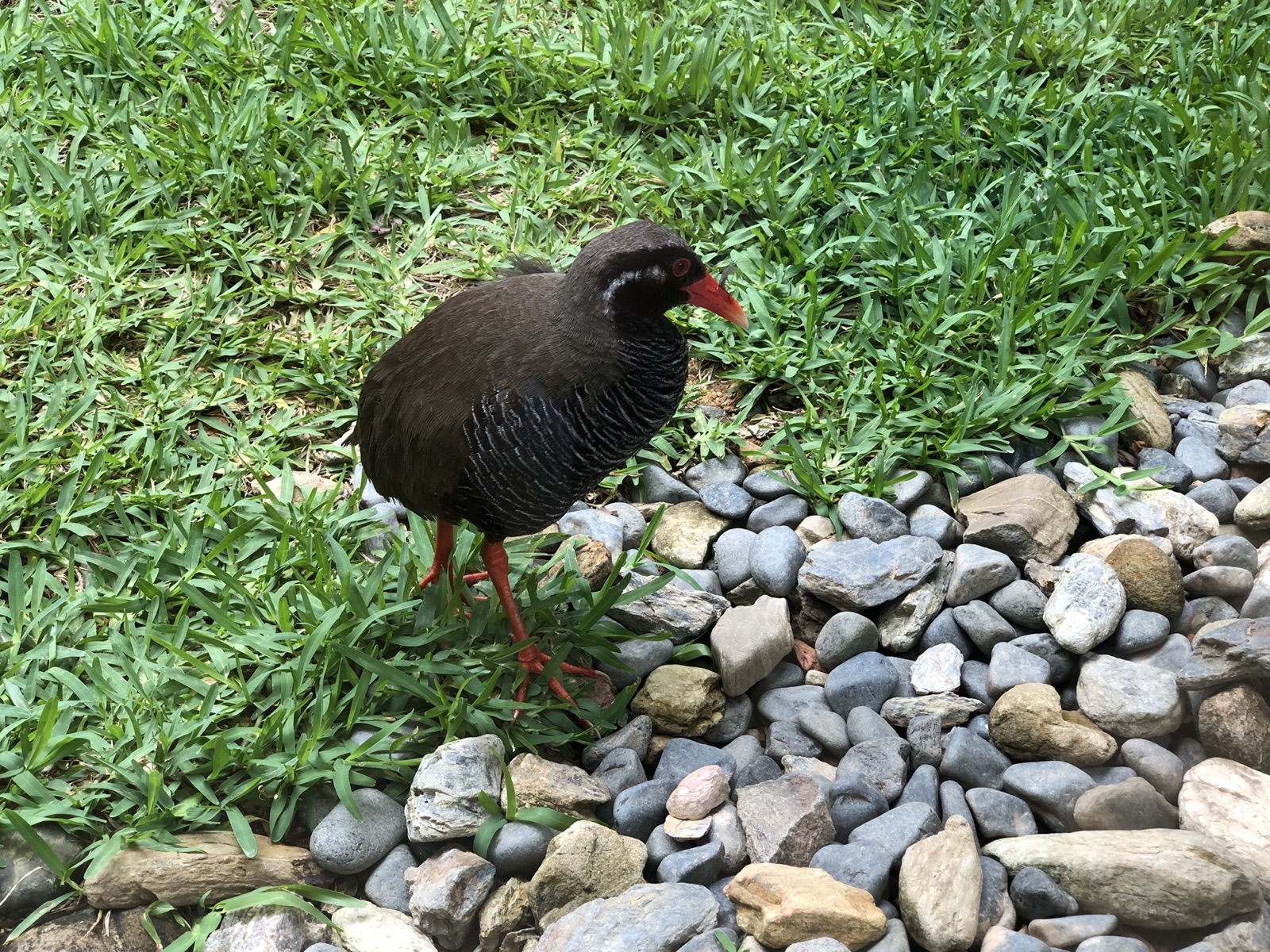
The Okinawa Rail lives in one forest. Yanbaru, in the northern third of Okinawa, is one of Japan’s last subtropical rainforests, and the rail exists nowhere else in the world. It is medium-sized, chicken-shaped, flightless, with dark olive plumage and a red bill and legs. It was first reported in 1978; specimens were collected over the next three years, and the species was formally described in 1981. From the moment it entered the scientific record, it was already threatened.
I first saw one on a weekend drive to Kunigami, the northernmost of the Yanbaru villages. By that point I had already done my active-duty Air Force years in Germany and Omaha and had separated from the service. I was back in the Air Force world from a different seat. I worked at Kadena Air Base as a civilian Visual Information Specialist for the 18th Force Support Squadron, the team that runs the parks-and-recreation side of base life. On weekends and after work, I was doing field research for a college paper at Arizona State on the U.S. military’s environmental impact in Okinawa. The work I did Monday through Friday and the paper I was writing on the side were not in obvious conversation. I was an American living and working on a base in another country, and that was the position from which I drove north on a Saturday.
That contradiction is important to this story. But not yet. First, the bird.
The Okinawa Rail’s Japanese name is Yanbaru kuina. It belongs to the rail family, Rallidae, which includes several famous island flightless birds: the extinct Wake Island Rail, the extinct Laysan Rail, and the still-surviving Inaccessible Island Rail. Flightlessness on islands is a familiar evolutionary pattern. A flying rail colonizes an island, finds no ground predators, and over time its descendants stop investing in flight. Wings shrink. Legs strengthen. The bird becomes easier prey if predators are later introduced.
The mongoose was introduced to Okinawa in 1910, brought in by the Japanese zoologist Tetsugoro Watase to control habu vipers. It did not solve the snake problem. It ate rails. The species, classified today as the small Indian mongoose (Urva auropunctata, long known under the older name Herpestes javanicus), spread north into Yanbaru over the decades that followed, with additional releases reported in the late 1970s. Feral cats compounded the damage. The result has been a century of decline.
When I visited the Rail Ecology Center in 2018, a staff member walked me through the population history. Surveys put the population at roughly 1,800 birds in the mid-1980s, when systematic counts began. Numbers fell sharply in the years that followed, dropping to around 700 by the early 2000s. More recent estimates put the wild population near 1,500, held in that rough range by active intervention. Government programs trap mongoose in Yanbaru. Volunteer groups run trap-neuter-release efforts for feral cats. The rail is a conservation success only in the narrowest sense: it still exists. It is also a species that could vanish in a bad decade.
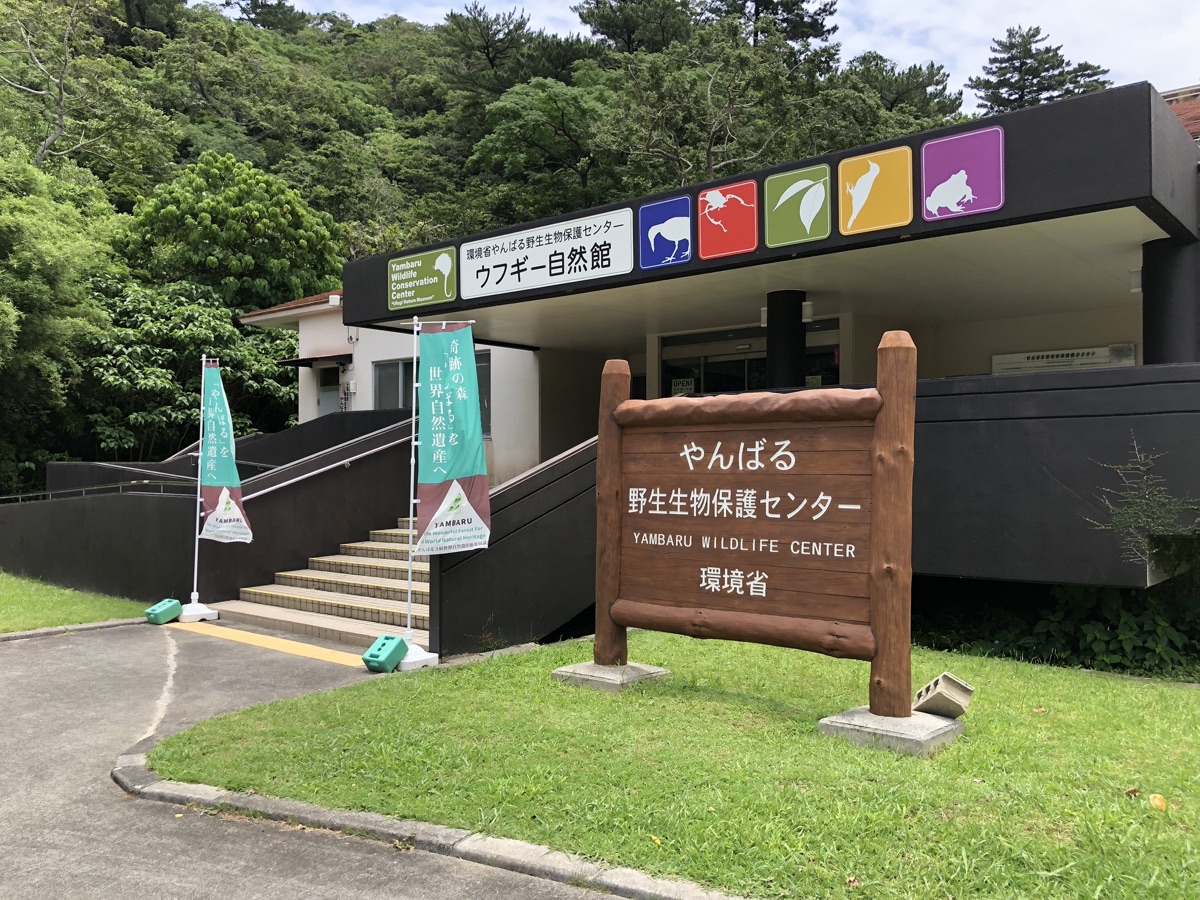
Yanbaru itself is dense and wet, with evergreen broadleaf canopy and bamboo in the understory. The Okinawa Woodpecker lives there. The Ryukyu long-tailed giant rat lives there. Ishikawa’s frog lives there. It is not an ordinary forest, and there is nowhere else in Japan quite like it.
The most alarming thing I heard at the Rail Ecology Center was about understory clearing. The rail feeds and nests on the forest floor, though it also roosts in trees at night. It hides in dense lower vegetation, where it forages for snails, amphibians, insects, and small lizards. When the understory is cleared for roads, helipads, or service access, the rail loses both cover and food at once. A rail in a thinned forest is a rail in a predator exhibit.
The U.S. military footprint in Okinawa has historically included substantial access to Yanbaru. The paper by Itô, Miyagi, and Ota [3] describes the extinction crisis facing the region’s endemic species and notes that the Camp Gonsalves Jungle Warfare Training Center occupies about a quarter of the Yanbaru region. Over time, land returns have been paired with other construction, including new helipads elsewhere in the forest. Those are not minor concessions. In a habitat that depends on intact understory, building access roads and landing sites is an environmental intervention, not a procedural one.
I did not understand most of this when I first arrived in Okinawa. I knew it was beautiful. I knew Kadena was big. I had been told in onboarding (at both Kadena and, later, at Marine Corps Community Services) that as an American living and working on a base in another country, I was an ambassador for the United States in a place where locals had complicated feelings about the ongoing American presence. I understood “ambassador” to mean, roughly, don’t get drunk and loud off base. The part about forests and birds was not covered.
I was taking a long-distance class at Arizona State and needed a research paper topic. I chose the military’s environmental impact in Okinawa because I was there and it seemed like useful due diligence: What do the people who live here think about us, and what are the actual effects we’re having? I read Congressional Research Service reports [1]. I read ethnographic work on the noise of U.S. military aircraft over Okinawa [2]. I read Itô, Miyagi, and Ota on the extinction crisis facing Yanbaru’s endemic species [3]. I read legal filings and scholarly analysis of the Okinawa dugong case [4, 7], in which conservation groups argued in federal court that the Department of Defense was violating preservation law by building over dugong habitat, alongside reporting on what the ruling meant for northern Okinawan aid [5]. I read scholarly accounts of the long protest history [6]. I read about Osprey crashes. I read about the Henoko landfill proposal and the coral reef in Oura Bay.
And then I drove to Kunigami to talk to the people doing conservation work on the ground.
What they told me, in essence, was this: the big fights are about base construction and policy, and those are fought by lawyers, governments, and international pressure on a timescale that does not help the rail in any given year. What service members can do directly is address introduced species. Spay and neuter your cats. Keep them indoors. Do not abandon pets when you rotate out. Do not dump exotic pets into the environment. Drive slowly in Yanbaru, because the rail crosses roads and cannot fly over cars.
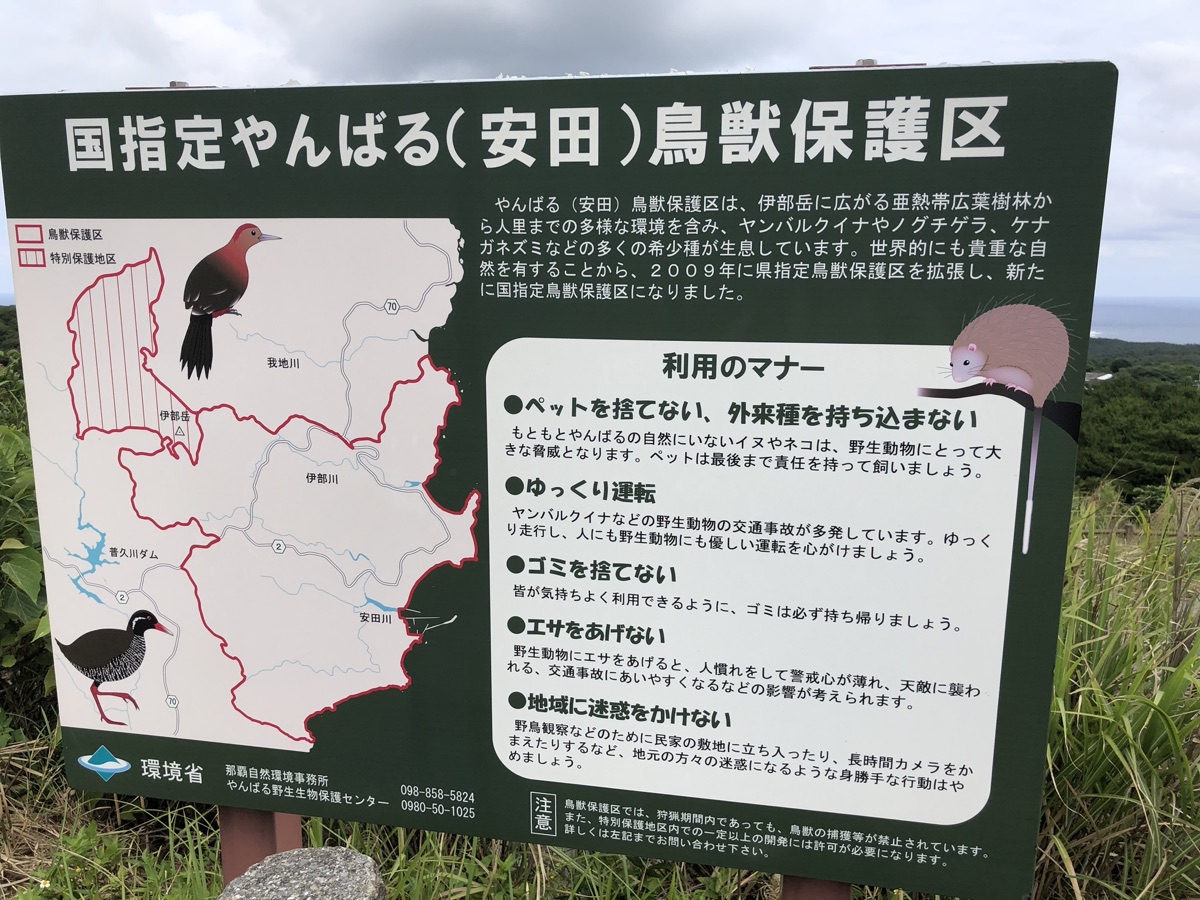
The cat issue was the specific lesson. Service-member pet abandonment is one contributor to the feral cat population on the island. Personnel sometimes bring pets onto assignment and leave them behind when they rotate out. An abandoned pet either dies or becomes feral; either way, it becomes part of an ecosystem that did not evolve with it. Feral cats are efficient hunters of ground-nesting birds, and the rail is a ground-nesting bird.
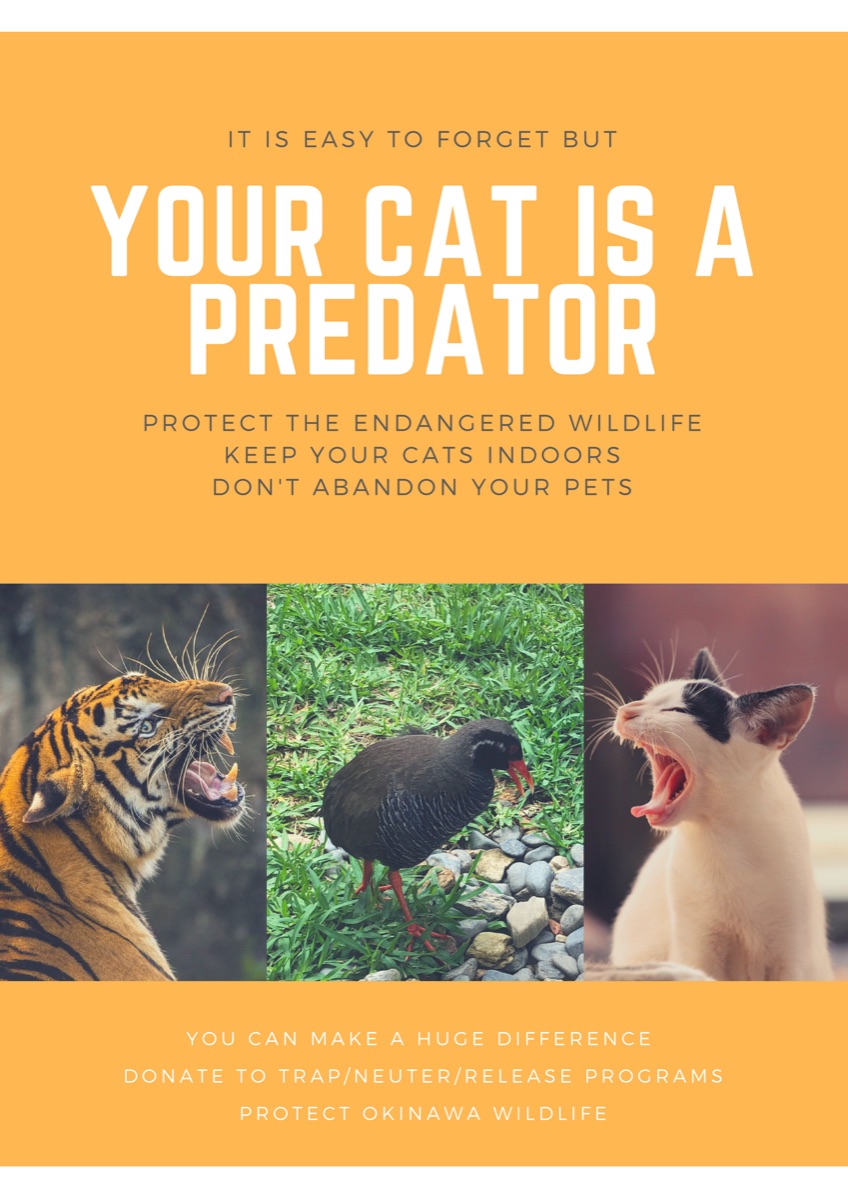
I wrote the paper [8]. I made a poster to accompany it. The poster said: Your cat is a predator. Protect endangered wildlife. Between an image of a tiger and an image of a kitten, I placed a photograph of an Okinawa Rail. The point was simple: the domestic cat, which most Americans treat as a companion, can become part of an extinction pipeline on a small island that happens to hold one of the rarest birds in the Western Pacific.
I did not know then that I was becoming a birder.
The paper was not a great paper. I reread it this week, and the arguments are earnest, the citations are serviceable, and the prose is unmistakably student prose, the kind that starts paragraphs with “Despite this.” But it was the first thing I wrote that treated a bird as a specific organism whose existence depends on specific conditions humans can alter.
Before that paper, birds were background. I saw them; I didn’t look at them. After it, I couldn’t walk in Yanbaru without scanning the understory for movement. I couldn’t drive the northern roads without watching the edge of the asphalt. A rail crossing would appear as a dark shape, low and careful, then vanish into vegetation. I never got a long look. I wasn’t trying to.
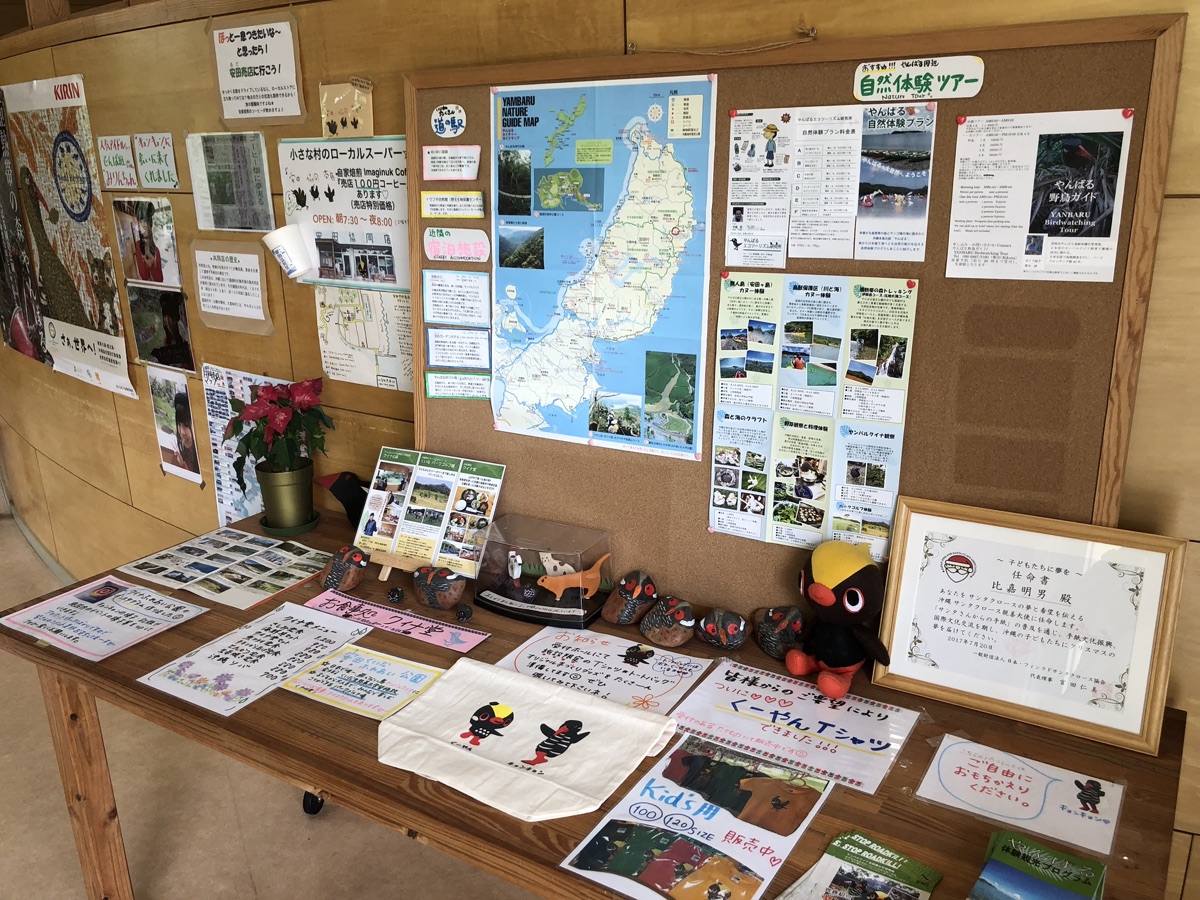
What I developed, without naming it, was a practice of attention. A new kind of object had entered the category of things I noticed.
When I left Okinawa, came back to the United States, and eventually moved to New York, that practice came with me. It wasn’t Okinawa Rails anymore, because Okinawa Rails do not live in North America. It was Northern Cardinals and House Sparrows and Rock Pigeons, which I had ignored my whole previous life. Then it was the warblers in Central Park. Then the woodcocks in Bryant Park. Then it became this column.
Two things stayed with me, and I’ve been writing from both of them ever since.
First: a bird is a specific organism with specific conditions. You cannot write about birds generically. Every bird story is about a particular species in a particular place facing particular threats and opportunities. Generality is the enemy of attention.
Second: the conditions birds depend on are political. Forests are political. Cats are political. The feral cat population in northern Okinawa is political because it is shaped, in part, by thousands of American personnel bringing pets onto a fragile island ecosystem and leaving them behind. The Ramble in Central Park is political because a century of advocacy protected it as a sanctuary. The glass facade of the Javits Center is political because bird advocates fought to make it safer. To bird seriously is to notice that the birds you see are there because someone made specific decisions, and the birds you do not see are missing because someone else made different ones.
I write about those decisions at shellylynnx.com now. The line from an earnest college research paper in 2018 to the Subway Birder column in 2026 runs through the Yanbaru forest. The rail has not seen me since I left. I’m still writing for it.
One last observation from this year.
I was standing by a pond in Prospect Park, watching a Louisiana Waterthrush work a muddy bank, when I thought about how the species probably will not be here in large numbers in fifty years. Southern birds are moving north. Northern birds are running out of continent. A warbler that migrates from Central America to the eastern United States every spring depends on a chain of forests along a flyway, and that chain is changing faster than the bird can adapt.
The Okinawa Rail, being flightless and tied to one forest, cannot run out of continent. It either has Yanbaru or it doesn’t. That is a clearer relationship than most birds have with habitat. I think that is why the rail stayed with me. The dependency is visible. You can see the forest. You can see the bird. You can see what happens when the forest goes.
Every bird has that kind of relationship to some version of its habitat. Most of the time it is complicated by distance and migration and multiple countries. The rail is a clarifying case. Once I understood its case, I could not stop seeing the same pattern in every other bird I watched. The rail was the bird that taught me how to see them all.
Birds Mentioned
Subway Routes
Show routes (2)
- 23FGBQProspect Park (where I watched a Louisiana Waterthrush this spring)2 or 3 to Grand Army Plaza for the Long Meadow north entrance. F or G to 15 St-Prospect Park for Lookout Hill and the lake. B or Q to Prospect Park for the east side. Quiet ponds along the watercourse pull migrants like the Louisiana Waterthrush in spring.
- BC16Central Park, the Ramble (where the warblers come through)B or C to 72 St or 81 St-Museum of Natural History, then walk east into the park. 1 to 79 St or 6 to 77 St for the east-side approach. Peak warbler diversity runs the last week of April through the first two weeks of May.
Credits
All photographs by Shelly Xiong, Yambaru Wildlife Conservation Center, June 2018. PSA poster created by Shelly Xiong, 2018.
References
Show references (8)
- Congressional Research Service. The U.S.-Japan Alliance, Report RL33740, 2016
- R. Cox. The Sound of Freedom: US Military Aircraft Noise in Okinawa, Japan, Anthropology News 51(9): 13–14, 2010
- Y. Itô, K. Miyagi, and H. Ota. Imminent Extinction Crisis Among the Endemic Species of the Forests of Yanbaru, Okinawa, Japan, Oryx 34(4): 305–316, 2000
- Center for Biological Diversity et al.. Okinawa Dugong v. Mattis (case background and filings), U.S. District Court for the Northern District of California; Ninth Circuit
- Takehiko Kambayashi. Ruling to protect dugong could put Northern Okinawa aid at risk, Christian Science Monitor, February 5, 2008
- Arasaki Moriteru. The Struggle Against Military Bases in Okinawa: Its History and Current Situation, Inter-Asia Cultural Studies 2(1): 101–108, 2001
- Miyume Tanji. U.S. Court Rules in the 'Okinawa Dugong' Case, Critical Asian Studies 40(3): 475–487, 2008
- Shelly Xiong. Field Report on Yanbaru and the Okinawa Rail, Arizona State University, 2018