The 22-Year-Old Who Helped Invent Modern Birdwatching
Florence Merriam Bailey was 22 when she became the AOU's first female associate member. She helped invent modern birdwatching from inside a movement, not its edges.
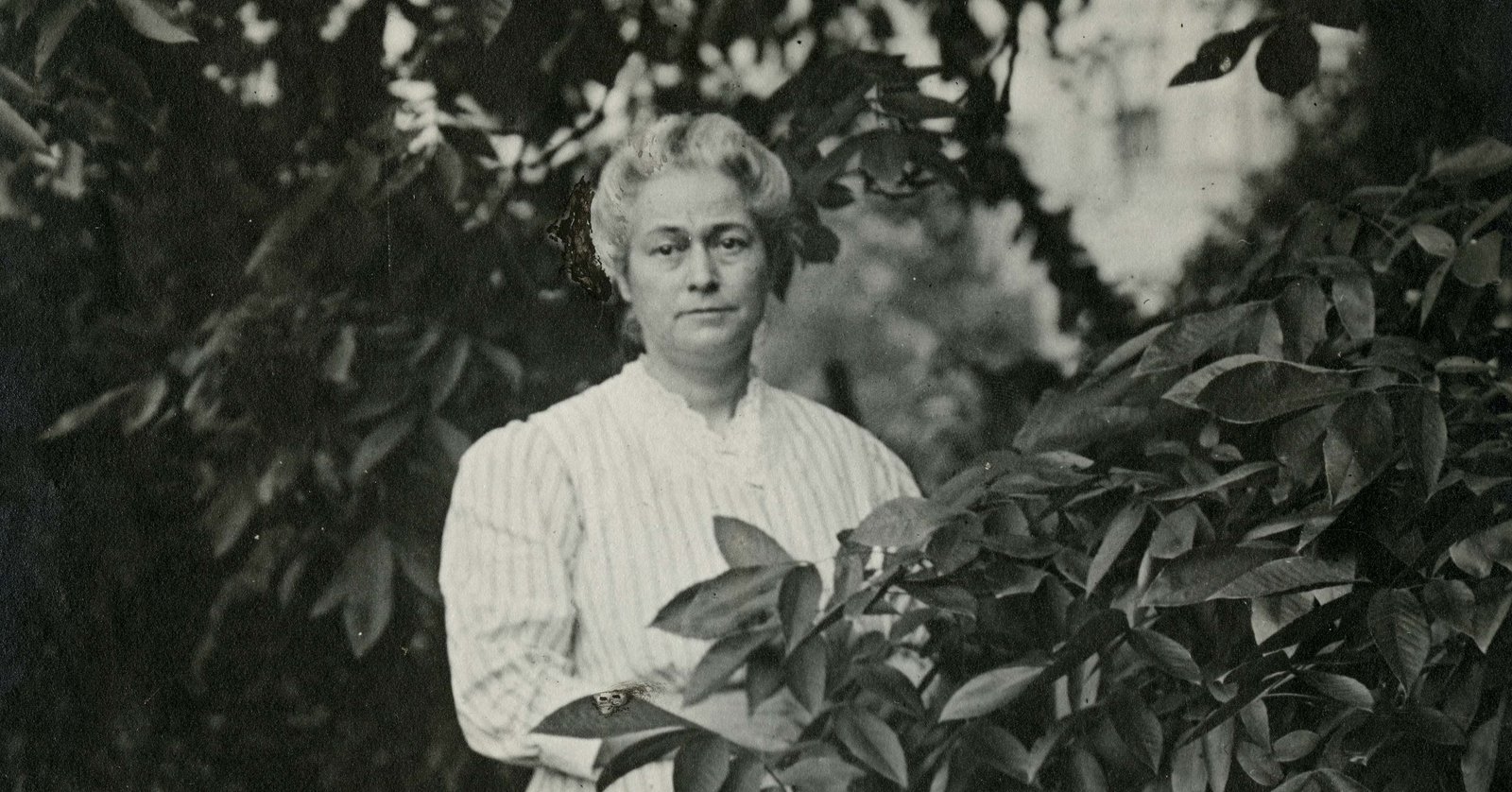
For most of the nineteenth century, the way to study an American bird was to shoot it first.
The fashion industry had a similar approach. By the late 1880s, roughly 5 million birds a year were being killed to decorate American women’s hats [1]. Snowy Egrets and Great Egrets for the long white plumes. Common Terns sewn whole onto hatbands. Songbirds for color, herons for size. A network of women, with a handful of male scientific allies, decided to stop it. They could not vote. They organized anyway: tea-party boycotts in Boston parlors, Audubon chapters at colleges and women’s clubs, field guides written for general readers, lobbying that pushed Congress to pass the Lacey Act in 1900, the Weeks-McLean Law in 1913, and the Migratory Bird Treaty Act in 1918. By the time the Treaty was implemented, the commercial plume trade had been sharply curtailed, and birdwatching had begun to take hold in public life.
One of the women inside that movement was 22 years old in 1885 when she became the first female associate member of the American Ornithologists’ Union. The following year, with her Smith classmate Fannie Hardy, she helped organize an early college chapter of the Audubon Society. Four years after that, she published Birds Through an Opera Glass, one of the earliest illustrated field guides for general readers. Her name was Florence Merriam Bailey.
The first field guide
In 1889, Bailey published Birds Through an Opera Glass. The premise is in the title: identify the bird with an opera glass, the portable field instrument of the era, a small pair of magnifying lenses that a young woman could fit in her pocket and use on a walk.
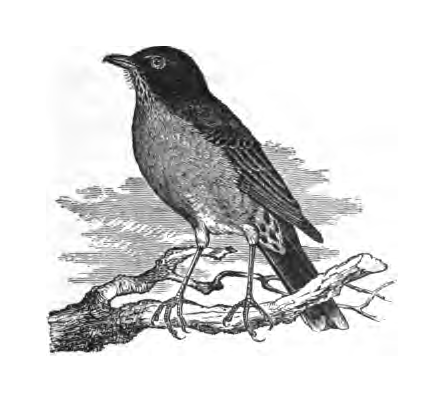 American Robin, the first species in Birds Through an Opera Glass*. Inline illustration from Bailey’s chapter on the species (book p. 5).* View in the gallery →
Through the late nineteenth century, American ornithology was largely a specimen science, and many ornithological texts of the period still assumed a collector’s point of view.
Birds Through an Opera Glass assumed something different. It was written for someone who might see a bird on a walk and want to know its name. The implied reader was young, probably female, probably just curious. The implied toolkit was an opera glass. In the context of 1889, that reframing was the radical part.
Her ear was unusually careful. The book gives the Wood Pewee three distinct song transcriptions, not one, including a phrase she heard at dawn and dusk that differed in pace and phrasing from the standard daytime call. The behavioral psychologist Wallace Craig formally described the Wood Pewee’s twilight song in his 1926 paper The Twilight Song of the Wood Pewee, which became the foundational scientific account of the species’ multi-form vocal repertoire [2]. Bailey had three of those forms on the page in 1889, 37 years earlier, with no theory attached and no claim made about it. She just transcribed what she heard.
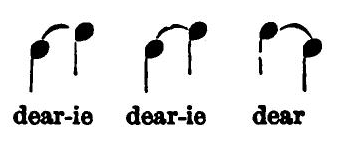 One of Bailey’s three Wood Pewee transcriptions from Birds Through an Opera Glass*, page 87. The syllables “dear-ie dear-ie dear” sit beneath the inline music notation.* View in the gallery →
Smith College, 1886: an early chapter
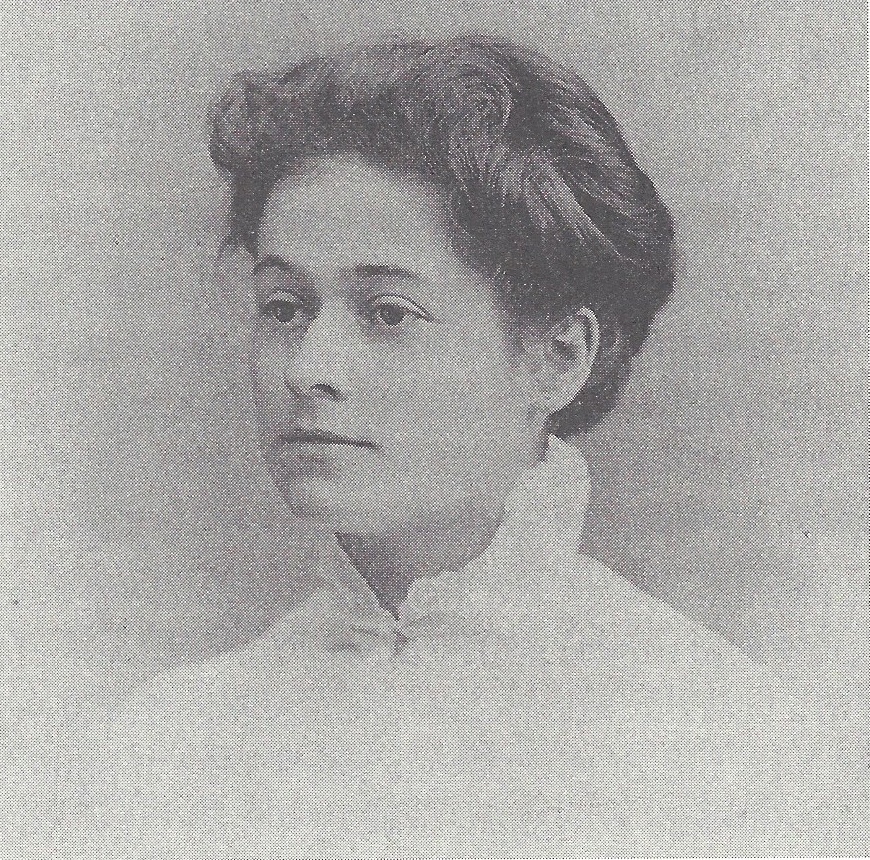 Florence Merriam Bailey in 1886, the year she helped found the Smith College Audubon chapter. Photograph by Notman Photographic Company; from the Smith College yearbook.
In her senior year at Smith, Bailey helped organize an early college chapter of the Audubon Society, with her classmate Fannie Hardy (later Eckstorm). About 75 students and faculty attended the first meeting. By March 17, 1886, the chapter had a constitution, officers, and a field committee [3].
It is worth noting what kind of school Smith was at the time. When Bailey enrolled, the college didn’t even offer biology courses. She wrote her senior thesis on evolution anyway.
The strategy she and Hardy chose for the chapter was specific. They didn’t lecture the other students about feathered hats. They took them birding. Bailey invited the naturalist John Burroughs, the Hudson Valley nature writer who was already a household name in 1886, to visit Smith and lead nature walks that May. By the end of the visit, according to chapter records cited by Audubon historians, a substantial fraction of Smith’s student body had quit wearing feathered hats and joined the Audubon Society. The conversion was not from guilt. It was from having seen a live warbler.
This is a more useful political theory than most.
The Boston tea parties and the network
Smith was not alone. In 1896, the Boston society women Harriet Hemenway and Minna Hall consulted the Blue Book, the city’s social register, and launched a series of tea parties where they informed their friends, with citation, that women’s hats were driving entire bird species toward extinction. Roughly 900 women joined the boycott [1]. That same year, Hemenway and Hall founded the Massachusetts Audubon Society. The Connecticut Audubon Society followed in 1898, organized by Mabel Osgood Wright and others.
These were upper-class white women using the only political instruments they had available, consumer power and social-network organizing, in the absence of the vote. They were also strategic. Hemenway and Hall knew the plume trade, the fashion industry, and the millinery press were all run by men, so they recruited prominent male Boston bird experts to lend the new society institutional credibility. They built coalitions because they had to.
Bailey was inside this network from the beginning. Her close friend Olive Thorne Miller, the writer who encouraged her early career and taught her how to observe birds without being noticed by them [4] (and whom Bailey would later eulogize in The Condor after Miller’s death in 1918), was a politically active member of the Brooklyn Woman’s Club and Sorosis. The four women historians later named as the most important American bird-book authors of the 19th century, Florence Merriam Bailey, Olive Thorne Miller, Mabel Osgood Wright, and Neltje Blanchan, all knew each other or each other’s work. They were not parallel pioneers. They were a coordinated movement.
The New York thread
The institutional architecture they worked inside was not coincidental. The American Ornithologists’ Union had been founded in New York City in 1883, three years before Bailey’s Smith chapter, at the American Museum of Natural History. Her older brother, C. Hart Merriam, was a founding member of the AOU and was elected its first secretary. He had also helped found the Linnaean Society of New York five years earlier, in 1878, alongside John Burroughs (the same naturalist who would later visit Smith at her invitation) [5]. The intellectual center of American ornithology in the 1880s was Manhattan, and Bailey grew up adjacent to it.
She joined that center on her own terms. In 1885, at age 22, she became the first female associate member of the AOU [6]. She was admitted to a club that, until her, had been entirely male, in a city that was simultaneously the headquarters of American science and one of the largest markets for plume-trade hats in the country. She walked into both rooms.
From the West, on a horse
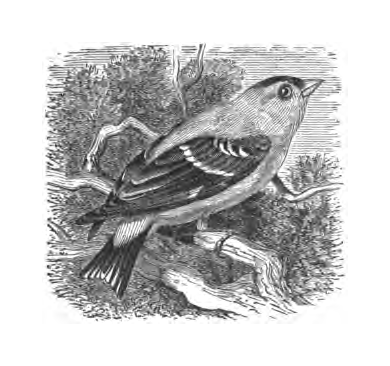 American Goldfinch (Yellow-Bird) inline illustration from Bailey’s chapter on the species, Birds Through an Opera Glass*, page 77.* View in the gallery →
In 1893, Bailey contracted tuberculosis. Like many TB patients of her era, she was sent west for the climate. She convalesced at her uncle’s ranch in Twin Oaks Valley, California, then spent six months at Stanford University, which was being run by her brother’s friend David Starr Jordan [7]. She birded.
What she did with that exile mattered. Out of it came A-Birding on a Bronco (1896), a memoir of her California fieldwork on horseback, illustrated by a young Cornell student named Louis Agassiz Fuertes who would later become America’s most important bird illustrator. Then Birds of Village and Field (1898). Then her Handbook of Birds of the Western United States (1902), the companion volume to Frank M. Chapman’s Handbook of Birds of Eastern North America (1895). Together, the two handbooks covered the continent.
She was in her early 30s when she started this work, riding through the Southwest on a horse named Canello, taking field notes during what would otherwise have been a slow, indoor recovery. Decades later, in her sixties, she went back into the field one more time and produced Birds of New Mexico (1928), the monograph that won her the Brewster Medal in 1931. She did her best fieldwork while sick, and her final masterwork in old age.
The firsts, and the federal arc
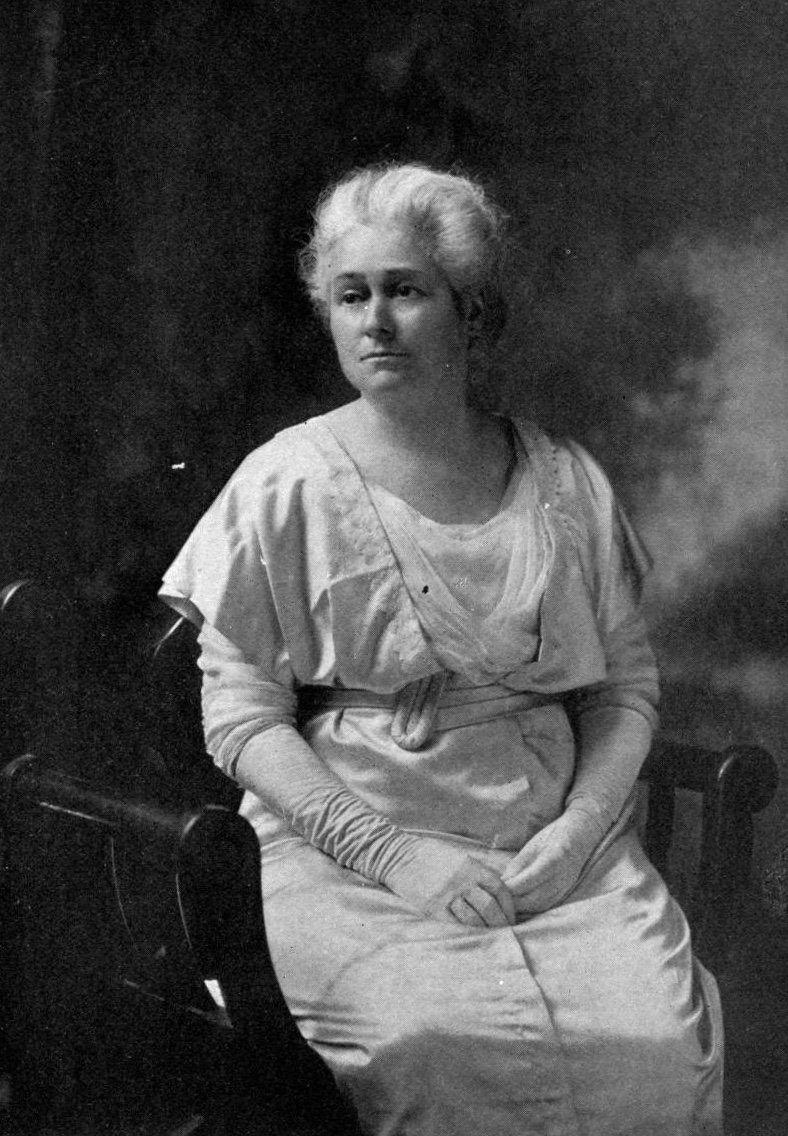 Florence Merriam Bailey in 1916. Portrait from Bird-Lore magazine.
Bailey was the first female associate member of the AOU in 1885 and the first woman elected a Fellow of the AOU in 1929, 44 years later [6, 8]. She was the first woman to receive the AOU’s Brewster Medal in 1931, at the time the most prestigious award in American ornithology, for Birds of New Mexico. The American Ornithological Society’s Florence Merriam Bailey Award goes to an early-career woman for outstanding publication today [9].
In Washington, where she lived for most of her adult life after marrying Vernon Bailey in 1899, she served on the AOU’s Committee on Bird Protection [10]. (Vernon Bailey was Chief Field Naturalist of the U.S. Biological Survey, the agency her brother had founded fourteen years earlier. Washington was a Merriam family town.) The Lacey Act of 1900, which prohibited interstate trade in birds taken in violation of state laws, was the first federal pass at protecting wild birds. It was poorly enforced, but it was the first crack in the plume trade’s legal cover. The Weeks-McLean Law of 1913 effectively ended the commercial plume trade. The Migratory Bird Treaty Act of 1918, the implementing legislation for a treaty between the United States and Canada (extended to Mexico in 1936) that still legally protects American birds from commercial hunting, exists on the far end of that 30-year arc.
Florence Merriam Bailey was inside all three of those campaigns.
What she changed
Every time you hold up a pair of binoculars and ID a bird without touching it, you are doing the specific practice Bailey helped formalize. Every time a young birder shows up to a Saturday walk in Central Park with a phone and Merlin, they are the inheritors of that 1886 Smith College chapter. The commercial plume trade was sharply curtailed by the early twentieth century, in large part because of the broader movement she was inside. Roger Tory Peterson’s 1934 A Field Guide to the Birds exists because Bailey and her cohort had spent the previous 45 years building an audience for a field-identification book aimed at non-collectors.
Birdwatching is not a neutral hobby. The cultural infrastructure around it (field guides for non-scientists, Audubon chapters, binocular-first identification protocols, women in ornithology) was shaped between roughly 1886 and 1918 by a network of late-Victorian women working with a small group of male scientific collaborators, and much of that infrastructure traces back through a 22-year-old in Northampton, Massachusetts, who decided her classmates were going to stop wearing dead birds.
The opera glasses have been upgraded. The argument hasn’t.
A note on her name. Bailey published under several variations during her lifetime: Florence A. Merriam, Florence Merriam, Florence Merriam Bailey, Mrs. Vernon Bailey. She married Vernon Bailey, a field naturalist, in 1899; her bibliographic record straddles the name change. I have used Florence Merriam Bailey throughout for clarity.
Read the full book → Birds Through an Opera Glass: the interactive 1889 field guide. Bailey’s complete text, all 70 chapters, with her original illustrations and song notations placed inline where she set them on the page. Public domain, free to read.
Browse the full gallery → Birds Through an Opera Glass: An Illustrated Gallery. All 16 of Bailey’s bird drawings and 11 of her song transcriptions, with one of her sentences about each species.
Birds Mentioned
Subway Routes
Show routes (2)
- BC1M79 SBSM10American Museum of Natural History (where the AOU was founded in 1883)B or C to 81 St-Museum of Natural History puts you at the museum's Central Park West entrance. 1 to 79 St is one block east. Cross-town M79 SBS runs through Central Park; the B is weekday-only.
- BC16M79 SBSM86 SBSCentral Park, the Ramble (NYC's most-watched birding patch)B or C to 81 St or 1 to 79 St on the west side; 6 to 77 St or 86 St on the east side. The Ramble sits mid-park between 73 and 79 St. Cross-town M79 SBS and M86 SBS run through the park.
Credits
Hero portrait: Smithsonian Institution Archives, RU007417 Florence Merriam Bailey Papers (public domain). 1886 Smith College photograph by Notman Photographic Company. 1916 portrait from Bird-Lore magazine. American Robin, Wood Pewee song notation, and American Goldfinch illustrations from Birds Through an Opera Glass (1889), scans courtesy of Internet Archive. All images public domain.
References
Show references (10)
- How Two Women Ended the Deadly Feather Trade, Smithsonian Magazine
- Craig, Wallace. The Twilight Song of the Wood Pewee: A Preliminary Statement, The Auk, 1926
- Florence Merriam Bailey, New York Historical Society, Women & the American Story
- Bailey, Florence (1863-1948), Encyclopedia.com
- About the Society, Linnaean Society of New York
- Florence Merriam Bailey, Wikipedia
- Florence Augusta Merriam Bailey, Britannica
- The First Lady of American Ornithology: Florence Merriam Bailey, Golden Eagle Audubon
- Florence Merriam Bailey Award, American Ornithological Society
- Florence Merriam Bailey Papers, 1865-1942, Smithsonian Institution Archives